Researchers:
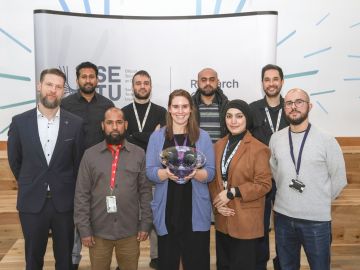
Dr Marcos Mariano, Ms Tess Ames, Dr Laurence Fitzhenry - The Ocular Therapeutics Research Group (OTRG)
Challenge:
More than 2.2 billion people worldwide live with a vision impairment or blindness, while hundreds of millions more experience chronic eye diseases that reduce quality of life and require lifelong treatment. Despite major advances in medicines, conventional eye drops remain highly inefficient, with most of each dose lost before reaching the eye, leading to frequent treatment, poor adherence, and limited effectiveness. Many promising discoveries also fail to progress beyond the laboratory because of technical, regulatory, and commercial barriers.
Impact Summary:
The OTRG has transformed pioneering ocular drug delivery research into a growing portfolio of commercially relevant healthcare technologies. Through multiple research programmes, The OTRG has generated four patent families, established strategic partnerships with industry, clinicians and patients, and produced the scientific evidence required to de-risk technologies for commercialisation and future clinical translation. The programme has strengthened Ireland's innovation ecosystem through intellectual property, follow-on investment, and spin-out creation (OcuHealth, OcuDel), while embedding patient and public involvement throughout technology development. Collectively, these impacts are improving the pathway from laboratory discovery to patient benefit, economic growth, and global healthcare innovation.
The Ocular Therapeutics Research Group (OTRG) has transformed fundamental ophthalmic research into a programme of technology translation, creating new opportunities to improve patient care while strengthening Ireland’s life sciences and innovation ecosystem. Its research addresses a key challenge in eye healthcare: developing treatments that can be delivered effectively and safely in formulations that patients can use and tolerate. While dry eye disease has been a major focus, the technologies and translational approach have wider applications across ocular diseases and drug delivery.
The OTRG has progressed multiple ocular drug delivery technologies towards commercial application, supported by four patent families covering complementary drug delivery and ophthalmic formulation technologies. These have transformed publicly funded research into protected commercial assets, creating opportunities for licensing, industry collaboration, investment and product development. The technologies have attracted commercial interest, including collaboration with a multinational company to adapt OTRG’s nanoparticle platform for new biomedical applications. The strength of the research and commercial potential has also contributed to approval for a new spin-out company, due to commence operations in 2026.
Through projects including OcuHealth, funded through Enterprise Ireland’s Commercialisation Fund, and the ONE DROP SETU PhD programme, the OTRG has reduced the technical and commercial risks associated with early-stage healthcare innovation. Lead dry eye technologies demonstrated more than 18 months’ stability, prolonged drug retention on the eye compared with conventional drops, controlled drug release and strong preclinical safety. This evidence has increased confidence among industry partners, investors, clinicians and other stakeholders and brought the technologies closer to clinical and commercial development.
Additionally, the OTRG has developed an international ecosystem spanning academia, clinical research, industry and technology transfer, collaborating with more than 25 organisations across 12 countries, over 70 research collaborators and 10 active research and innovation projects. University College Dublin strengthened translational and preclinical research, Experimentica provided independent efficacy, pharmacokinetic and safety validation, and SETU’s Technology Transfer Office supported IP protection, commercial strategy and industry engagement.
The impact extends beyond individual technologies, strengthening SETU’s capacity for translational research, commercialisation and international collaboration while generating IP, industry partnerships, investment and spin-out opportunities. OTRG has also contributed to INNOVISION, an internationally recognised MSCA Co-Fund programme that secured more than €500,000 from international partners and €1.6 million from Horizon Europe. As technologies continue to progress towards clinical adoption, OTRG has already demonstrated measurable impact by converting research into protected IP, commercial opportunities, patient-informed innovation and an internationally connected pathway towards future health, economic and societal benefits. Additionally, OTRG’s work on embedding Patient and Public Involvement and Engagement (PPIE) has secured an additional €50,000 in interdisciplinary funding, established a sustainable patient contributor network within SETU, and contributed to SETU’s progression towards participation in the €10 million PPI Ignite Ireland programme.
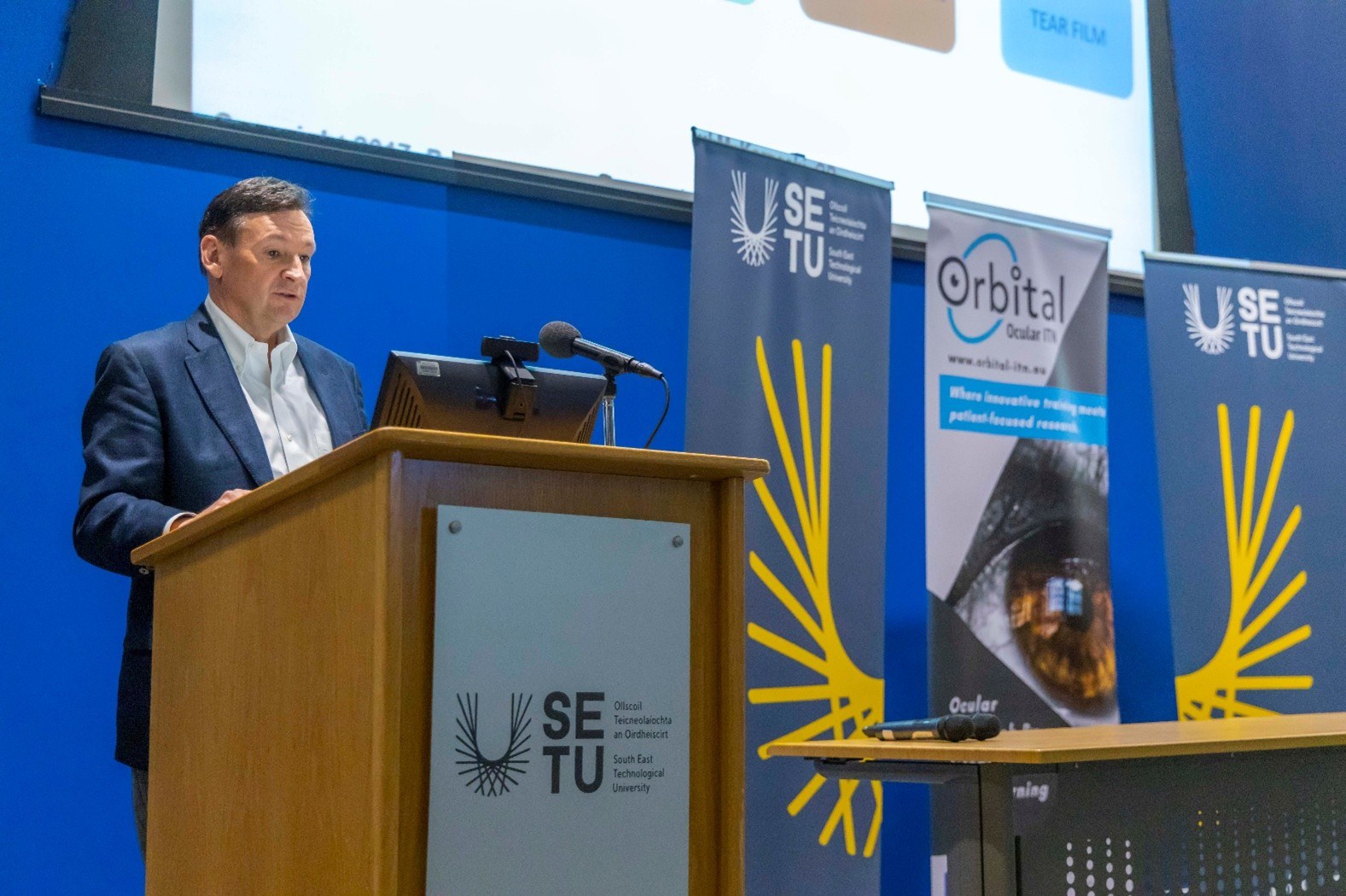
The OTRG has spent more than a decade developing a portfolio of advanced lipid-based nanoparticle platforms (LNPs) that improve how medicines are delivered, retained, and released within ocular tissues. While dry eye disease has served as the lead demonstration case, the technologies developed by Dr Laurence Fitzhenry and his team have been designed as adaptable delivery platforms with potential applications across multiple ocular diseases and therapeutic agents.
The research addresses a fundamental limitation of conventional eye drops. Typically, less than 5% of an administered dose reaches its intended target because medicines are rapidly diluted and washed away by tears and the eye's natural drainage mechanisms. As a result, patients often require frequent dosing, experience poor treatment adherence, and may not receive the full therapeutic benefit of their medication. The OTRG's research sought to overcome this challenge by engineering LNP systems capable of retaining medicines on the ocular surface for longer, improving drug penetration, enabling controlled drug release, and enhancing patient comfort.
The research is novel not only in its formulation technologies but also in their translational design. OTRG developed adaptable delivery platforms capable of incorporating multiple therapeutic agents, including established medicines such as dexamethasone and emerging compounds such as naringenin, across medicated eye drops, artificial tears and hydrogel-based systems. By improving the delivery of existing and emerging therapeutics, these platforms create opportunities for longer-lasting, more effective and patient-friendly treatments, while potentially supporting simpler regulatory pathways through the use of established medicines.
This research has progressed through a series of complementary studies that collectively demonstrate the scientific foundation underpinning The OTRG's technology transfer activities. Early work by Kumari et al. (2021) established the potential of nanostructured lipid carriers for ocular drug delivery. Building on this foundation, Sarfraz et al. (2025) demonstrated successful pilot-scale manufacture of a twin nanoparticulate delivery system, significantly improving ocular absorption and prolonging retention of dexamethasone compared with conventional formulations. In parallel, Golestaneh et al. (2026) highlighted the significant health burden and complex patient experience associated with dry eye disease, reinforcing the need for longer-lasting, patient-centred therapeutic approaches.
Laboratory, ex vivo and preclinical studies demonstrated that the lead formulations achieved prolonged drug retention on the ocular surface, controlled drug release, excellent biocompatibility, and improved pharmacokinetic performance while maintaining stability for more than 18 months. These findings provided the robust scientific evidence required to support future manufacturing, regulatory progression, and commercial development. More recently, research by Mariano et al. (2026) and Asghar et al. (2026) has expanded the platform beyond conventional eye drops by demonstrating the stability of these technologies under sterilisation and storage conditions and adapting them for hydrogel-based biomaterial systems in collaboration with industry. This work illustrates how the underlying platform can be translated across multiple therapeutic applications and commercial markets.
PPIE was embedded throughout the research programme, with more than 700 patients and members of the public contributing through interviews, surveys, workshops, information events and discussion forums (Figure 1). Their insights on comfort, dosing frequency, ease of administration, treatment burden and adherence directly informed formulation design and delivery platforms, ensuring innovation addressed real-world clinical needs.
Patenting
The project is supported by four granted patent families covering complementary lipid-based ocular formulation technologies:
- Ocular drug delivery (NLC family): US patent granted October 2023, with related EP and WO applications. Waterford Institute of Technology listed as assignee.
- Microemulsion for ophthalmic drug delivery (LME family): European patent granted July 2025, with unitary effect registered across multiple EU member state s. A divisional EP application is pending. Waterford Institute of Technology listed as assignee.
- Artificial tears (NLC family): European patent granted March 2026, with related applications pending in US and JP. Waterford Institute of Technology listed as assignee.
- Intention to grant for the divisional for NLC in the US 2026 – pending.
Publications
1. Sarfraz et al. Development and in vitro and ex vivo characterization of a twin nanoparticulate system to enhance ocular absorption and prolong retention of dexamethasone in the eye: from lab to pilot scale optimization. 23 Apr 2025, Nanoscale Advances. 7, 10, p. 3125-3142 18 p. (Published)
2. Farooq et al. Design of liposomal nanocarriers with a potential for combined dexamethasone and bevacizumab delivery to the eye. 3 March 2024. International Journal of Pharmaceutics, 654, 123958. (Published)
3. Kumari et al. Dexamethasone-Loaded Nanostructured Lipid Carriers for the Treatment of Dry Eye Disease. 9 June 2021, pharmaceutics. 13, 905. (Published)
4. Golestaneh et al. Comorbid health conditions among adult individuals with dry eye disease: A systematic review of quantitative and qualitative studies. Expert Review of Ophthalmology Journal. (Submitted)
5. Sarfraz et al. Comparative long-term stability and bioavailability studies of developed nanotechnologies (Planned).
6. Sarfraz et al. Comparative ocular bioavailability and efficacy studies of developed nanotechnologies (Planned).
7. Mariano et al. Colloidal stability of cholesterol-stabilized nanoemulsions under sterilisation and storage conditions (Waiting Submission)
8. Asghar et al. Influence of Lipid Composition on colloidal Stability and porcine Corneal Distribution of Naringenin-Loaded nanoemulsions (Under development)
Prizes and Awards
- Research and Development Irish Pharma Award (2023): https://research.setu.ie/en/prizes/research-and-development-achievement-award-3/
- Research Impact Case Study Award – Runner Up, Public Impact (2025) https://research.setu.ie/en/prizes/research-impact-case-study-runner-up/
- PI Dr Laurence Fitzhenry was awarded the Post Graduate Supervisor Award at SETU Research Excellence Awards, 2026
- The Ocular Therapeutics Research Group was awarded Research Excellence Award, 2026
- OcuHealth wins Venture Launch 2025: https://www.setu.ie/news/ocuhealth-wins-venturelaunch-2025-as-setu-ucd-partnership-advances-new-eye-treatment
- OcuHealth takes third at the RETINNOVATE Conference 2025: https://www.flowcoevents.com/retinnovate
- The OcuHealth Project was noted in the Pharma Industry Awards 2026 as a contributing part of the PMBRC’s overall Research and Development Award, 2026
The OTRG wishes to acknowledge and thank its team members and diverse collaborators across SETU departments and campuses, as well as patient and public contributors, industry partners and external stakeholders.
OTRG wishes to acknowledge and thank all funders, including, but not limited to, Enterprise Ireland, Research Ireland, Horizon 2020, Horizon Europe. the MSCA Postdoctoral Co-Fund, the PPI Ignite Network (HRB), and WIT/SETU PhD Scholarship programmes.
This research contributes to the United Nations Sustainable Development Goals (SDGs) 3, 8, 9, and 17.