

Researchers
Dr Niamh Maguire - Crime and Justice Research Group
Challenge:
For most of the 20th century, inconsistency in sentencing was widely accepted as an inevitable feature of the Irish justice system. The media portrayed sentencing as a "lottery," with outcomes depending more on which judge a defendant appeared before than on the offence they were convicted of. Frequent criticism of judges and their decisions can undermine public confidence in the justice system and this in turn, can undermine the rule of law and, ultimately, democracy Yet, holding public decision-makers accountable and scrutinising their decisions with robust, evidence-based data is also essential for maintaining public confidence in the fairness and legitimacy of our justice system and in our democracy
This need for transparency, consistency and evidence-based scrutiny is particularly acute in the context of gender-based violence. Since 1996, 284 women have died violently in Ireland, with 87% of perpetrators male and known to the victim (Women's Aid, 2026). The 2024 EU gender-based violence survey found that 35% of Irish women had experienced psychological, physical, and/or sexual abuse from an intimate partner, with 25% experiencing sexual violence as an adult from an intimate partner (FRA, 2024). Against this backdrop, concerns about judicial and sentencing practices take on a particular significance. In its 2023 baseline evaluation of Ireland, the Council of Europe's GREVIO raised concerns about the the frequent use of lenient, suspended, and conditional sentences for violence against women, noting that this may suggest such offences are treated as less serious than other crimes.
Impact Summary:
Dr Niamh Maguire’s research has had significant impact on the Irish justice system, influencing sentencing policy, practice and legal culture. Her work has contributed to a shift in legal culture from the acceptance of inconsistency in sentencing as a natural consequence of an individualised sentencing system towards it being perceived as an unacceptable feature requiring structural reform. Maguire’s research has improved our understanding of the complex relationship between penal policy and practice and contributed to legislative, sentencing and penal policy developments aimed at improving the fairness, humanity, rationality and effectiveness of the criminal justice system.
"The most significant piece of empirical criminal justice research to take place in Ireland in recent years… instrumental in informing both the Probation Service's approach to developing community sanctions and communicating them to judges, as well as our collaborative work to inform judicial practices and Department of Justice policy and legislative proposals... this report provides essential evidence to help government departments and bodies develop, and researchers advocate for, policies that will have the intended effect of a more humane, rational and effective criminal justice process."
Ian Marder, Associate Professor of Criminology at the School of Law and Criminology, Maynooth University, and leader of the national CORD Partnership describing the Maguire and Carr (2024), report.
In particular, her research has contributed to gender equality and efforts to address gender-based violence against women and girls by informing Ireland's first sentencing guideline on domestic violence, drafted by the Judicial Council in 2025. The guideline has since supported judges in the sentencing of domestic violence offences.
Impact on Sentencing Policy
Research on District and Circuit Court sentencing practices (Maguire, 2008, 2010, 2014) found high levels of inconsistency, rooted in both the structural incoherence of sentencing law and policy and in judicial variability. This work helped shift judicial and legal culture toward accepting that reducing inconsistency should be a core goal of the legal system. In its 2013 Report on Mandatory Sentencing, the Law Reform Commission (LRC) cited Maguire’s (2010) research in the District and Circuit Courts as evidence that a more robust approach was needed to improve consistency in sentencing and in identifying the need for a Judicial Council to develop sentencing guidelines in order to reduce inconsistency. Shortly, after the LRC’s 2013 Report the Criminal Court of Appeal (CCA) in March 2014 ushered in what O’Malley referred to as a ‘quiet revolution’ by delivering three guideline judgments aimed at structuring sentencing practices and increasing consistency in sentencing, thus reversing an infamous Supreme Court decision in The People (DPP) v Tiernan [1988] IR 250 in which it refused to issue sentencing guidelines. Despite the LRC’s recommendation in 2013 it took until 2019 before the Oireachtas introduced the Judicial Council Act, 2019. The Judicial Council is tasked with developing and monitoring sentencing binding sentencing guidelines on an onging basis, thus ultimately indicating an acceptance that consistency in sentencing is both desirable and necessary in the Irish justice system.
A 2024 study of judicial perspectives on District Court sentencing, commissioned by the Judicial Council (Maguire, 2024), found that most District Court judges now accept the importance of consistency and are applying a more structured approach, with most citing proportionality as their guiding principle. This marked a shift in judicial attitudes: from accepting inconsistency as unavoidable to treating consistency as essential to a fair, transparent, and inclusive justice system that supports public confidence in the rule of law. Further demonstrating the impact of Maguire’s research on sentencing consistency, the Irish Times (8 July 2024) reported that the Judicial Council adopted the key recommendations of this research, which called for: (1) sentencing guidelines specific to the District Court, grounded in the general jurisprudence of the superior courts; (2) better judicial awareness of community sanctions overseen by the Probation Service; and (3) sentencing guidance for domestic violence cases. Each recommendation has already produced concrete change, including:
A Supreme Court ruling on a sentence appeal that specifically addressed its implications for the District Court.
The District Court is the busiest criminal court in Ireland, hearing the majority of criminal cases and imposing more sentences than any other court, yet its decisions cannot be appealed directly to the Court of Appeal or Supreme Court. This has historically left it short of relevant sentencing guidance, since appellate jurisprudence is developed with higher courts in mind. Responding to the research recommendation that bespoke guidance be developed for the District Court, the Supreme Court in The People (DPP) v Montasser [2025] IESC 53 explicitly addressed, for the first time, how its judgment applied to the District Court, signalling that the court is bound by Supreme Court rulings in the same way as others, and that its sentencing jurisprudence should be expressly considered in future appellate judgments. Greater visibility of the District Court in such rulings should lead to a more structurally coherent, fairer, and more transparent sentencing system for all citizens.
Impact on penal policy
Dr Maguire’s 2014 research was used by the Law Reform Commission in its Report on Suspended Sentences (2020) as evidence for reiterating that prison should only be used as a last resort, strengthening the principle of fairness and proportionality in sentencing. Building on this, the Maguire and Carr (2024) report, commissioned by the Department of Justice to assess the impact of the Criminal Justice (Community Service) Amendment Act 2011, informed the Probation Service's approach to developing community sanctions and communicating them to judges, as well as collaborative work shaping judicial practice and Department of Justice policy and legislative proposals on the greater use of community sanctions. This led to legislative amendment, guidance for District Court judges on community sanctions from the Judicial Council, and input into the Probation Service's implementation strategy for CSOs, together supporting a fairer penal system in which people convicted of minor offences are more likely to receive a punishment proportionate to their crime.
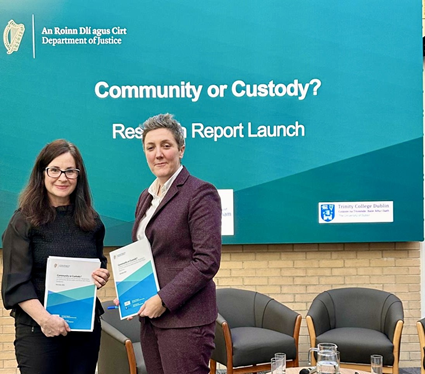
In response to Maguire and Carr’s 2024 Report, the Minister for Justice included an amendment to the Criminal and Civil Law (Miscellaneous Provisions) Bill 2026 increasing the maximum hours of a CSO from 240 to 480, (equivalent to prison sentences up to 24 months). A group of academics from a number of universities specialising in criminal justice policy, probation, sentencing, and community service orders, also proposed a further amendment, requiring judges who find a CSO unsuitable, to consider a probation order before imposing a short prison sentence, aiming to steer sentencing further toward community sanctions. This amendment was debated at several parliamentary committee stages. Deputies Garry Gannon and Mark Ward were key political collaborators in advancing this amendment at Justice Committee and Report Stage (link to Oireachtas debates in evidence section).
In response to findings that District Court judges had limited information on community-based sanctions, influencing their use of prison for minor offences, and following a recommendation in both research reports (Maguire, 2024; Maguire and Carr, 2024), the Judicial Council published a Note on Community Sanctions in Ireland with Specific Reference to the District Court on its website. Describing the impact of the Maguire (2024) and Maguire and Carr (2024) reports, Deputy Garry Gannon told the Dáil, during debate on the Courts and Civil Law (Miscellaneous Provisions) Bill 2025:
"Last year, South East Technological University, in research commissioned by the Department of Justice, examined how judges view community service orders... Judges, particularly outside of Dublin, continue to rely on short custodial sentences, of less than 12 months, even though every piece of evidence tells us they do nothing to reduce reoffending... That same excellent piece of research highlighted that almost half of District Court judges do not have a probation officer regularly sitting in their court, and just as many lack access to community service suitability reports... Another study for the Judicial Council by SETU reached the same conclusion, that judges need sentencing guidelines on non-custodial sanctions, better training on alternatives to custody and a major reinvestment in the Probation Service... Judges in every court should have the tools, training and information to see probation and community sanctions not as letting someone off but as a structured, supervised path out of reoffending."
Impact on gender equality
As noted earlier, a 2023 GREVIO baseline report on Ireland raised concerns about judicial and sentencing practices in cases of violence against women, suggesting that such crimes were being treated as less serious than other violent offences. Informed by Maguire’s research (2024) on judicial perspectives on sentencing relationship violence, and in response to its recommendation, accepted by the Judicial Council (see Irish Times, 8 July 2024), that bespoke sentencing guidance be introduced for domestic violence cases, the Judicial Council published its first-ever sentencing guideline in May 2025: the Report on the Application of Section 40 of the Domestic Violence Act 2018. The Judicial Council recently adopted the sentencing guideline on the 25th of March 2026. The guideline explains why an offence committed against a current or former intimate partner is an aggravating factor warranting a more severe sentence than the same offence would attract without that relationship. It has already been used in numerous cases to inform sentencing outcomes in domestic violence matters and serves as a visible signal that gender-based violence is taken as seriously as other violent crime. In DPP v Montasser [2025] IESC 53, the Supreme Court referred to the substantial research (Maguire, 2024) and consultation underpinning the draft guideline. This strengthens judges' ability to sentence domestic abuse in a fairer, more transparent, and more structured way, one that recognises the distinct harms of gender-based violence and directly addresses the concerns raised by GREVIO and other commentators that such violence was being treated as less serious than other violent crime.
Maguire 2008, 2010, 2014
This doctoral research was the first to explore how judges pass sentence in the Irish District and Circuit Courts. Using a qualitative approach combining in-depth interviews and sentencing vignettes (both established methods in international sentencing research), judges were asked about the circumstances in which they would impose a custodial sentence and whether they agreed that "prison should be used sparingly and only for the most serious cases where no other sanctions are appropriate." Judges were also asked to "pass sentence," while thinking aloud, on vignettes designed to sit at the threshold between custodial and non-custodial outcomes.
The research found greater inconsistency in District Court sentencing than in the Circuit Court, largely because District Court judges commonly prioritised "doing justice" in the individual case over achieving consistency, and because the District Court, unlike the Circuit Court, lacked sentencing guidance from appellate review (Maguire, 2008, 2010). A second key finding was that although judges accepted the principle that prison should be a last resort, they rarely applied it in practice (Maguire, 2014).
Maguire and Carr (2024), Community or Custody
Using similar methods to the doctoral study, this commissioned research focused specifically on District Court judges' attitudes to short prison sentences and community service orders (CSOs). It found that judges did not regard CSOs as equivalent in severity to short prison sentences, and that they excluded many offender groups from consideration for a CSO: for example, those with extensive previous convictions were seen as "beyond rehabilitation," and those with substance misuse issues as too chaotic to complete one (Carr and Maguire, 2025; Maguire and Carr, 2026). Professor Carr and Dr Maguire presented these findings to the Probation Service at their Community Service Conference in Portlaoise on 18 November 2024.
Maguire (2024), Judicial Perspectives on Sentencing and the Sentencing of Relationship Violence
Commissioned by the Judicial Council, this research relied primarily on interviews with District Court judges, supplemented by sentencing vignettes, to explore the challenges they face when sentencing generally and when sentencing relationship violence cases, particularly breaches of protective orders (safety, protection, and barring orders) under section 33 of the Domestic Violence Act 2018.
The findings showed a marked shift in judicial attitudes to consistency, from the acceptance of inconsistency identified in earlier research (Maguire, 2010) to a recognition of consistency as an important goal. Long case lists pressured judges toward sentencing options that allowed cases to be finalised quickly, and judges had limited awareness of the community sanctions available to them. In domestic violence cases specifically, judges took divergent approaches: some applied family law reasoning rather than sentencing principles, and some viewed physical violence as more harmful than psychological violence. The Judicial Council fully adopted the study's key recommendations in 2024, and they informed its first-ever sentencing guideline.
Impact Evidence
- Law Reform Commission’s Report on Mandatory Sentencing (LRC 108-2013) [paragraphs 1.103 to 1.128 LRC links findings on consistency in sentencing (Maguire 2010): https://www.lawreform.ie/_fileupload/Reports/r108.htm#_ftnref211
Judicial Council meeting 25 March 2026 which adopted Sentencing Guideline relating to the offences captured by Section 40 of the Domestic Violence Act 2018. https://judicialcouncil.ie/sentencing-guideline-domestic-violence-act-2018/
- Irish Times on the introduction of sentencing guidelines: https://www.irishtimes.com/news/crime-and-law/a-quiet-revolution-occurred-this-month-sentencing-guidelines-were-introduced-1.1741707
- Judicial Council District Court Research - South East Technological University: https://judicialcouncil.ie/district-court-research-south-east-technological-university/
- Judicial Council Sentencing Guideline Domestic Violence Act 2018:https://judicialcouncil.ie/sentencing-guideline-domestic-violence-act-2018/
- Irish Times Report on Consistency in sentencing https://www.irishtimes.com/crime-law/2024/07/08/judicial-council-committee-adopts-proposals-for-more-coherent-sentencing-by-district-courts-for-domestic-violence-offences/
- Law Reform Commission Report on Suspended Sentences (2020) para. 4.29 to 4.31 notes Maguire (2014) https://www.lawreform.ie/_fileupload/Reports/LRC%20123-2020%20Suspended%20Sentences.pdf
- Oireachtas Report on Pre-Legislative Scrutiny of the General Scheme of the Criminal Law and Civil Law Miscellaneous Provisions Bill 2-25. (Recommendation 13) 2025-11-13_report-on-pre-legislative-scrutiny-of-the-general-scheme-of-the-criminal-law-and-civil-law-miscellaneous-provisions-bill-2025_en.pdf
- Garry Gannon’s contribution to the Dail debate on the Courts and Civil Law (Miscellaneous Provisions) Bill 2025. Dail Debate: Courts and Civil Law (Miscellaneous Provisions) Bill 2025: Second Stage https://www.oireachtas.ie/en/debates/debate/dail/2025-11-06/37/#spk_339
- Oireachtas Library & Research Service, 2026 Bill Digest No. 1 of 2026: Criminal Law and Civil Law (Miscellaneous Provisions) Bill 2026. (Community or Custody Report cited on page 12 and 13)
Media relating to Maguire (2024), District Court Perspectives on sentencing relationship violence:
- https://www.irishtimes.com/crime-law/2024/07/08/judicial-council-committee-adopts-proposals-for-more-coherent-sentencing-by-district-courts-for-domestic-violence-offences/
- https://www.lawsociety.ie/gazette/top-stories/2024/july/district-court-judges-want-bespoke-training--survey/
- https://www2.courts.ie/view/judgments/65e8d336-3a3c-42ce-99c2-8ea994d373a8/6186f21b-671f-429e-ac40-72082db23f87/2025_IESC_53_O'Malley%20J.pdf/pdf
Publications
- Maguire (2008) ‘Sentencing in Ireland: an exploration of the views, rationales, and sentencing practices of district and circuit court judges’, Trinity College Dublin, Ireland. School of Social Work and Social Policy.
- Maguire, N (2010) Consistency in Sentencing in Judicial Studies Institute Journal 2 (14)
- Maguire, N (2014) When is Prison a Last Resort? Definitional Problems and Judicial Interpretations, Irish Criminal Law Journal 24(3) 62
- Maguire, N. (2024) A Study of District Court Judges Views on Sentencing and the Sentencing of Relationship Violence. Dublin: The Judicial Council
- Maguire, N. and Carr, N. (2024) Community or Custody? A Review of Evidence and Sentencers’ Perspectives on Community Service Orders and Short-Term Prison Sentences. Dublin: Department of Justice.
- Carr, N. and Maguire, N. (2025) Community Service Orders in Ireland: Implementation, Impact and Judicial Perspectives, Irish Probation Journal, volume 22, 169-188.
- Maguire, N. and Carr, N. (2026). ‘Routinised Practices and Propulsive Logic of Imprisonment: Sentencing Repeat Offenders to Short Prison Sentences’ in J. Drápal, & J. V. Roberts (Eds.), Who Goes to Prison? International Perspectives on Structuring and Restricting the Use of Imprisonment (Palgrave Studies on Sentencing). Palgrave Macmillan.
- Professor Nicola Carr, TCD
- Associate Professor Ian Marder, Maynooth University
- Associate Professor Louise Kennefick, Glasgow University
- Senior Lecturer Eoin Guilfoyle, Leeds University
- This research was commissioned by the Department of Justice and the Judicial Council.