Research team: Dr Paula Carroll, Dr Noel Richardson, Professor Michael Harrison, Dr Tom Egan, Dr Gillian Ormond.
Challenge:
Men experience significantly lower life expectancy and poorer health outcomes than women. The lack of health and health related services that appeal to men is a significant factor; men underutilise traditional services as they are often perceived as ‘women’s spaces’. In 2015 there was little evidence of gender competent services for men in Ireland, and to date, such services rarely achieve national scale sustainably for population benefit. Furthermore, despite Ireland’s unique position of having a national men’s health policy since 2008, men are often not recognised in other health related policy and today, they remain underserved. This research proposed to address these challenges by a) identifying a single site evidence-based men’s health intervention, b) garnering multistakeholder support to trial its replication across multiple sites and c) evaluating it when replicated to support its national delivery.
Impact Summary:
At its core, this research reached ‘hard to reach’ men who were inactive, experienced significant health risk and were underserved by traditional services. By engaging them a community based, gender sensitised programme they experienced significant physical, social and mental health improvements thereby improving the overall quality of their lives. There is also evidence from their significant others that they and their families experienced positive ripple effects from men’s involvement in terms of their health and wellbeing and quality of life. Importantly, the levels of men’s engagement in this programme challenged the societal narrative regarding gender norms, masculinities and men’s health. It’s evident that men do engage with appropriate services and are keen to be more empowered to improve their health. As a result of this research, this programme is now delivered nationally across 22 counties in Ireland and has been specifically named in the 2016 and 2024 National Men’s Health Policies (MNHAP) as a programme the HSE and Sport Ireland (SI) should continue to support and for others to learn from with respect to scaling evidence-based practice (EBP).
“..I think the confidence in yourself and even the very fact that I cut back on my medication. Now I don’t want to go back to where I was.” 'Men on the Move' Participant
“The fact that it was led nationally for me was critical. We felt we had the proper direction, we felt that we had the proper tools and there was confidence in all the tools and resources which made it so much easier and that is important.” Local Sports Partnership Provider
“Well the whole thing was great, the atmosphere was just so good and that was between the younger and older. They were all mixed together, they were all talking, they were all having a great real laugh..” Local Sports Partnership Provider
Men on the Move – From Local Pilot to National Programme
Men on the Move (MOM) began in 2010 as an 8-week, community-based physical activity programme developed by the HSE Health Promotion and Improvement team with Mayo Local Sports Partnership (LSP). Its aim was simple but ambitious: to engage inactive men in enjoyable, accessible exercise.
In 2013, Dr Paula Carroll learned of the programme and conducted qualitative research as part of an independent evaluation commissioned by the Mayo LSP [see L. Canavan (2013) Available at: http://www.mhfi.org/mayomenonthemove.pdf]. This evaluation revealed that MOM was highly effective in reaching middle-aged men with cardiovascular risk, improving their physical health, and doing so cost-effectively. Inspired by these results, Dr Carroll worked with Mayo and Donegal LSPs to envision a national roll-out.
By 2014–2015, a partnership network of thirteen organisations, including eight LSPs, the HSE, Irish Heart Foundation, Men’s Development Network and academics, came together to redevelop the programme. The new format offered two one-hour sessions per week over 12 weeks, alongside workshops on diet and stress, a participant information booklet, pedometers, and personal tracking cards. SETU secured €217,644 in funding plus substantial in-kind support to deliver and evaluate the programme.
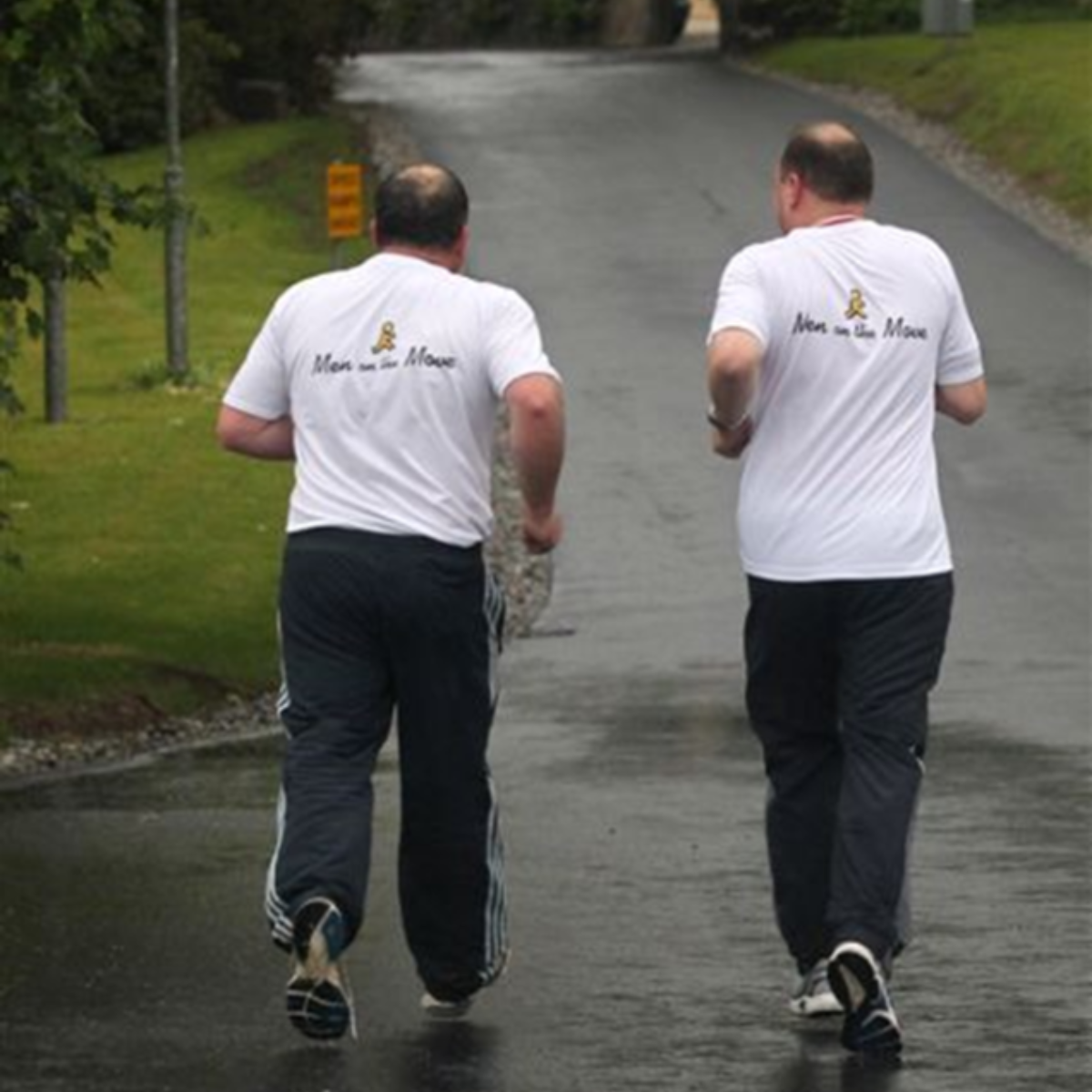
The 2019 national study confirmed MOM’s ability to reduce health risks and enhance social and mental wellbeing, while providing a blueprint for other LSPs. Following these results, Sport Ireland formally recognised men as a priority group, began promoting MOM on its website, and funded delivery nationwide. The HSE named MOM in the 2016 and 2024 National Men’s Health Action Plans, appointed a national coordinator, and formed a management group to train LSP staff in delivery.
Since 2010, MOM’s growth has mirrored its research journey, from a single programme in Mayo (2010–2013) to delivery in 2 counties (2013–2015), 4 counties (2015, when SETU research began), 8 counties (2016), and 22 counties by 2020. During COVID-19, many programmes were sustained online. With an average of 30 men per group and each LSP running 1–3 groups annually, it is estimated that around 6,000 men have participated nationally since roll-out. Many groups continue self-funded after the 12 weeks, or transition to other local activities, showing MOM’s lasting impact.
Awards
With research evidence from SETU supporting Mayo LSP’s delivery model, the programme was recognised for its innovation and impact, winning several prestigious awards:
- Local Authority Members Association Award (Mayo)
- Public Sector Magazine Award (National)
- Chambers Ireland Excellence in Local Government Award in the Best Health and Wellbeing category (National)
- Kelly L, Richardson N, Carroll P, Keohane A, Donohoe A, Harrison M, Robertson S. ‘Men on the Move’: A community-based physical activity programme for adult men in Ireland. 8th Conference of HEPA Europe 2017. 15th – 17th November 2017, Zagreb, Croatia. Plenary Session Presentation [Liam Kelly]- first prize for the HEPA Europe 2017 Early Career Research Awards
From just four pilot counties in 2015, MOM now runs in 22 counties across Ireland. The programme’s expansion reflects a shared commitment from national partners to improving men’s health, proving that when communities move together, the impact is lasting.
From the outset, the vision was to scale MOM nationally. Evidence shows only about half of EBPs bridge the research–practice gap, a process that typically takes 17 years. To shorten this, the team applied known strategies: secure buy-in from decision-makers, identify a population-wide delivery system, align with existing policy, demonstrate added value, ensure affordability and feasibility, build delivery capacity, develop protocols, and trial the programme under real-world conditions.
The MOM partnership network brought together local and national stakeholders, with the LSP network providing the delivery system. MOM aligned with men’s health policy and the LSP remit to increase physical activity. Co-developing the renewed programme with stakeholders ensured it was effective, affordable, and feasible. Capacity was built within the LSP system through ENGAGE training for 118 local service providers on gender and health, engaging men, and the MOM programme itself. Protocols and tools were distributed to standardise delivery. Crucially, the programme was trialled by those responsible for future national delivery. A hybrid evaluation and implementation design assessed: a) programme appeal, b) health impacts (physical, mental, social), c) economic value, and d) factors influencing success.
From September to December 2015, MOM was delivered by 4 LSPs (Waterford, Mayo, Donegal, Galway) in 12 new communities, with data collected at baseline, 3, 6, and 12 months. Comparison sites (n=12) were hosted by 4 other LSPs (Dublin City, Kilkenny, Limerick, Cork).
A total of 927 men participated (426 intervention, 510 comparison). Most were aged 40–70 (82%), white (98%), and married/cohabiting (78%), with nearly half holding a third-level qualification. Participants were predominantly overweight or obese (90%), over half had two or more cardiovascular risk factors, and 14% reported below-average mental wellbeing.
After 12 weeks, 74% of intervention participants improved aerobic fitness, 13.5% lost 5% bodyweight, and 48% reduced waist circumference by 5cm. At 52 weeks, these figures were 52%, 22%, and 42% respectively.
The programme was cost-effective, with a total cost per participant of €125.82, yielding 11.98 QALYs (5.3% health improvement) and a QALY cost ratio of €3,723, well below UK (£20,000) and Ireland (€45,000) thresholds.
Programmes currently being advertised
https://www.sportireland.ie/YPB/MOM
Information booklet for participants
Evaluation reports
- Men on the move: a community based physical activity programme for adult men in Ireland. Evaluation report: executive summary. - Drugs and Alcohol
- Men on the Move Evaluation Report
- http://www.mhfi.org/mayomenonthemove.pdf
Policy documents
- National Men’s Health Action Plan Healthy Ireland - Men HI-M 2017-2021 Working with men in Ireland to achieve optimum health and wellbeing.
- https://www.hse.ie/eng/services/publications/health-and-wellbeing/national-men-s-health-action-plan-2024-2028.pdf
Media
- https://www.kildarenow.com/news/home/423782/kildare-woman-leading-new-men-on-move-report-as-part-of-men-s-health-week.html#:~:text=A%20Co%20Kildare%20woman%20is,Evaluation%20Report%20earlier%20this%20week.
- https://x.com/CByrneMoS/status/1138766333024321536
- https://youtu.be/dhfbDJSC_v4?si=NysuK2xVEAgnqtjt
- Men on the Move | Sport Ireland
Youtube Videos (Testimonials)
- Men on the Move Dungarvan June 2017
- https://youtu.be/C9uB5jAF6iA?si=PCJYYuMrWyab9MBX
- https://youtu.be/IhoRa6uD4U4?si=wKeXGpjnxrcXqUw3
Research Publications
Kelly L, Harrison M, Richardson N, Carroll P, Egan T, Ormond G, Robertson S. (2021). Economic evaluation of ‘Men on the Move’, a ‘real world’ community-based physical activity programme for men. European Journal of Public Health, 31(1), 156-60.
Kelly L., Harrison M., Richardson N., Carroll P., Robertson S., Keohane A., Donohoe A. (2019). The impact of a gender-specific physical activity intervention on the fitness and fatness profile of men in Ireland. European Journal of Public Health, doi.orf/10.1093/eurpub/ckz100
Carroll P., Harrison M., Richardson N., Robertson S., Keohane A., Kelly L., Donohoe A. (2018). Evaluation of a Gender-Sensitive Physical Activity Programme for Inactive Men in Ireland: Protocol Paper for a Pragmatic Controlled Trial. Journal of Physical Activity Research, 3(1): 20-27.
Robertson S. Carroll P., Donohoe A., Richardson N., Keohane A., Kelly L., Harrison M. (2018). “The environment was Like They Were in The Pub but With no alcohol” – a Process evaluation of engagement and sustainability in men on The move an Irish community based Physical activity intervention. International Journal of Men’s Social and Community Health, DOI: 10.22374/ijmsch.v1i1.14.
Kelly L., Harrison M., Richardson N., Carroll P., Robertson S., Keohane A., Donohoe A. (2018) Reaching beyond the ‘worried well’: Pre-adoption characteristics of participants in ‘Men on the Move’, a community-based physical activity programme. Journal of Public Health doi.org/10.1093/pubmed/fdy134
SETU Research team: Aisling Keohane (MSc Candidate), Liam Kelly (PhD Candidate) and Alex Donohoe (Research Assistant).
Mentor and Supervisor: Professor Steve Robertson, Leeds Beckett University.
Research funded by the HSE with considerable benefit in kind from the LSPs, the Irish Heart Foundation and the Men’s Development Network.