
Researchers
Dr Leana Reinl, Prof Felicity Kelliher (BRIM-RIKON)
Challenge:
A new Frontiers Economics study (2026) reveals that gender parity in European entrepreneurship could generate €250 billion by 2040. Despite this potential, gender inequalities remain and women face persistent barriers that limit their growth and influence (Gender Equality Strategy 2026-2030). Often referred to as the ‘Glass Ceiling’, an EU 12% gender pay gap has only changed minimally over the last decade, the gender pension gap sits at 25% and male to female entrepreneurial activity is running at 2:1. While women continue to demonstrate resilience and innovation, their full potential/ participation in entrepreneurship remains constrained (GEM, 2025). These systemic inequalities are at odds with the Action Plan on Women in Research, Innovation & Startups 2030 and curtail crucial grassroots socio-ecological solutions and practices driven by women.
“Being a female entrepreneur does have its challenges. You have to explain yourself and your business more than a man would have to”.
Karen Keane, Bean and Goose Chocolate
Impact Summary:
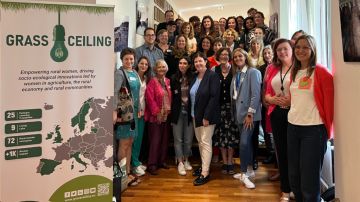
The SETU led GRASS CEILING project (2023–2025) developed Living Lab Capabilities to drive women-led rural innovation in Europe. The project demonstrated that participatory, place-based Living Lab approaches can strengthen innovation capabilities, confidence and influence of rural women, while informing more inclusive and responsive innovation ecosystems and policies. This project brought farmers, foresters, entrepreneurs, researchers and policymakers together, supported by BRIM-RIKON’s research-informed innovation framework. BRIM-RIKON trained 18 academic and practitioner co-leads, who subsequently supported 81 rural women innovators across nine countries to develop responses to socio-ecological challenges. Leading a Living Lab (LL) was a module of the project Massive Open Online Course (MOOC). Since 2023, more than 1,000 women have been trained via the LL, contributing to innovations with social, economic and ecological value. The LL enabled women to develop practical, community-based solutions to rural challenges while strengthening leadership, participation in decision-making and representation in policy discussions, generating insights for future gender-responsive rural innovation.
“Through the Living Lab, I collaborated with like-minded innovators to create practical, sustainable solutions that strengthen Ireland’s local food systems and inspired positive change in how we grow, source, and value our food and products”
Emer Lawrence, Irish Living lab participant
The GRASS CEILING project established nine Living Labs as testbeds for knowledge exchange, co-creation and training. Women co-created solutions to challenges affecting their innovation journeys and contributed to shaping policies impacting women innovators, generating new knowledge on the drivers and enablers of women-led innovation to inform policy development. Training incorporated narrative-based tools including Pecha Kucha, a visual storytelling methodology, and LEGO® SERIOUS PLAY®, a facilitated method for problem-solving and communication through the creation of metaphorical models. These approaches strengthened women innovators’ confidence, voice and ability to communicate their experiences, ideas, challenges and ambitions.
Women subsequently shared their co-created solutions and real-world insights at three Annual Showcase events, connecting their experiences with European and Irish stakeholders including the Women’s Entrepreneurship Platform, Copa-Cogeca, AEIDL, the European Environmental Bureau and Irish MEPs. This provided a direct route for women’s lived experiences, innovations and solutions to inform wider discussions on rural development, sustainability, entrepreneurship and policy. Success stories from GRASS CEILING Living Lab participants are featured on the GRASS CEILING website and YouTube channel. Examples of women innovators’ journeys and achievements include:
Bean and Goose
Co-founded by sisters Karen and Natalie Keane, Bean and Goose is an Irish chocolate company focused on sustainable production and collaboration with Irish producers and illustrators. The business has grown from a kitchen-based start-up to a dedicated workshop. As part of the GRASS CEILING project, Karen shared her experience of female entrepreneurship in the food industry and the company’s use of flexible working practices to support women in its workforce. The GRASS CEILING project offered a platform for Karen and Natalie to hone their mentorship skills and to enhance awareness of flexible working practices potential in small business.
Isle of Skye Zero-Waste Hebridean Wool Textiles
Aoife and her husband developed a business that transforms Hebridean wool, often considered a waste product, into handmade felted rugs and textiles, despite having no previous agricultural experience. As part of GRASS CEILING, Aoife shared her experience of developing the zero-waste process, the challenges that prompted the innovation, and how the business uses locally sourced wool and reflects the landscape of the Isle of Skye. The GRASS CEILING project offered Aoife a platform to exhibit sustainable practice regardless of business size.
Supporting Women’s Participation in Agricultural Cooperatives
Marloes van Schaik, an organic dairy farmer and policy advisor from the Netherlands, used the GRASS CEILING Living Lab to explore barriers to women’s participation in agricultural cooperatives and boards. Through interviews with farmers and board members, she developed practical recommendations to help cooperatives and associations create more inclusive environments that support women’s participation, confidence and representation in decision-making. The GRASS CEILING project offered Marloes confidence, access and legitimacy when engaging with these cooperatives and associations.
Policy Impact
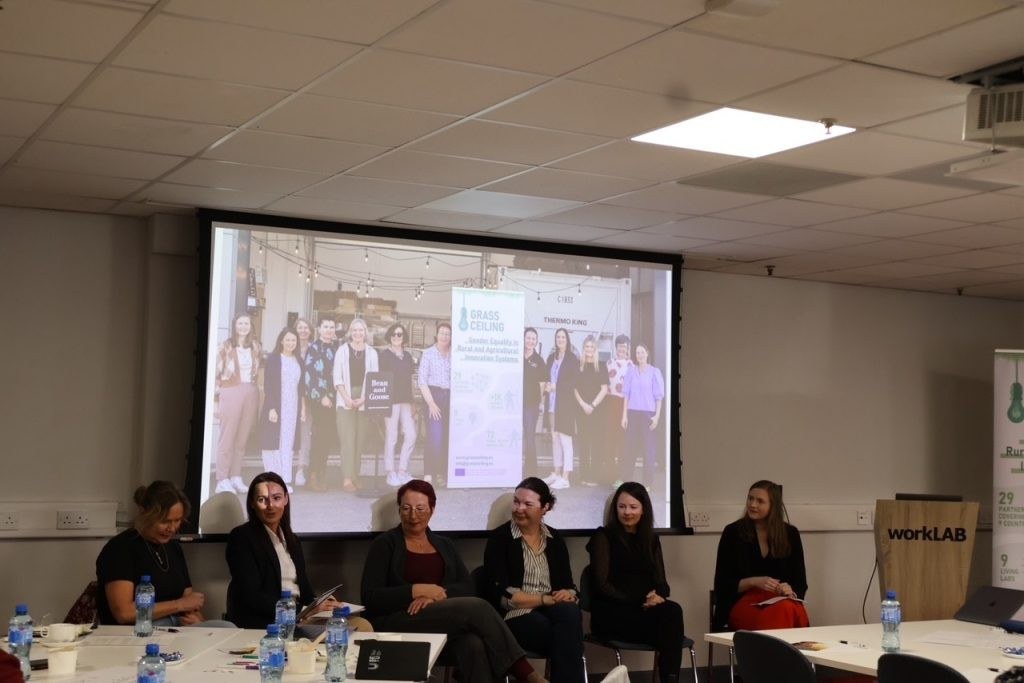
The Irish Living Lab brought together women innovators working across agri-food, rural and socio-ecological innovation. Participants identified that their voices had limited visibility within the Irish innovation and entrepreneurship ecosystem and were poorly reflected in policy documents intended to support them. Co-leads supported them to lead a 2025 policy and stakeholder symposium at workLAB, Waterford, attended by representatives from key government departments and support agencies.
At the event, participants highlighted systemic barriers to inclusion, including policy and support structures that prioritise business growth over community- and sustainability-focused innovation. The Department of Rural and Community Development and the Gaeltacht (DRCDG) subsequently circulated the participants’ recommendations and invited the women innovators to contribute to the public consultation informing the next iteration of Ireland’s Rural Development Policy, Our Rural Future (2026–2031).
Continuity and Further Research
Several Living Labs have continued beyond the project. In Scotland, the Wild Stream Project continues to develop and share resources through the National Innovation Centre for Rural Enterprise’s innovation portal. In Ireland, a SETU PhD is examining rural women’s innovation capabilities following the Living Lab experience; related research in Spain is investigating women farmers, innovation and support networks in depopulated rural areas. In Italy, participants continue to collaborate through a municipality-funded bio-district. To assess the longer-term impact of GRASS CEILING, BRIM-RIKON secured funding for follow-on research focused on the Irish Living Lab. A SETU PhD scholar commenced this research in 2025, with initial findings due to be presented at the International Small Business and Enterprise Conference 2026.
In April 2026, BRIM-RIKON was invited to engage with the European Network of Living Labs (ENoLL), an international association representing 200 members across 45 countries and 37 sectors. Following this engagement, BRIM-RIKON committed to sharing its MOOC module and tools supporting rural women-led innovation, supporting SETU/BRIM-RIKON’s progression towards ENoLL membership.
GRASS CEILING was selected by the European Commission as a ‘Success Story’, recognising its high societal impact and the contribution of the BRIM-RIKON Living Lab approach. EC evaluators highlighted the programme’s flexible approach and successful delivery of the Living Labs.
The GRASS CEILING Living Lab TTT programme was developed by BRIM-RIKON at SETU, drawing on established research into innovation (Kearney et al., 2018; Kelly et al., 2020), rural business communities (Kelliher, Reinl et al., 2018; Reinl & Kelliher, 2014, 2015), small business practice (Kelliher & Reinl, 2009) and Living Lab and innovator training methodologies. As Work Package 3 leaders of the SETU Horizon 2020 GRASS CEILING project (2023–2025), BRIM-RIKON applied this evidence through its research-informed innovation framework to develop and deliver a Living Lab TTT programme.
The methodology adopted a Participatory Action Research (PAR) approach, using iterative cycles of planning, action, reflection and adaptation. BRIM-RIKON trained 18 academic and practitioner co-leads, who subsequently supported 81 rural women innovators across nine countries to develop responses to socio-ecological challenges. Six co-lead review meetings, a cross-country focus group and structured reflections from co-leads and Living Lab leaders enabled the team to identify common themes, challenges and effective practices and continuously adapt the Living Lab model, training and resources.
The findings demonstrated that supporting rural women innovators requires flexible, relational and practice-based approaches. Effective Living Labs combined academic and practitioner expertise, diverse peer groups and stakeholder engagement with safe, trusting environments where women could share experiences, build confidence and develop innovation capabilities. Participants showed a strong preference for collaborative learning, storytelling and peer exchange, while flexible tools and locally adapted approaches were more effective than rigid innovation processes. The three-year programme was also found to be important in accommodating different innovation journeys and supporting confidence, social capital and innovation capacity.
These findings informed the development of practical innovation tools and resources included in the GRASS CEILING Rural Gender Toolkit and an open-access MOOC module on Innovation Living Labs, enabling the approach to be adopted by practitioners and policymakers beyond the project. By March 2026, the MOOC had generated 285 enrolments, 24 certificates and 436 student contacts, demonstrating reach beyond the original consortium.
The research also identified a gap between existing innovation support policies and the lived realities of rural women innovators, highlighting the need for longer-term, participatory and gender-responsive approaches. Recommendations include greater investment in facilitation and mentoring, flexible support mechanisms, targeted stakeholder engagement, and recognition of confidence, visibility, voice and networks alongside traditional innovation outcomes.
Relevant Publications
Reinl, L., Kelliher, F., Tynan, M., & Gannon, M. (Submitted: Under Review), Who am I, who are we? Negotiating rural women innovator identity. Journal of Rural Studies, Forthcoming Special Issue: Women entrepreneurs in the transition to sustainable agrifood systems: Entrepreneurial identity and the role of gender norms and institutional barriers.
Reinl, L., Kelliher, F., Tynan, M., Shortall, S., & Prendergast, M. (Accepted: Forthcoming). ‘Co-creating social learning strategies to support rural women-led innovation. ECBS ‘A research agenda for gender and innovation: key challenges and prospects for the future’. Edward Elgar Publishing Ltd.
Tynan, M., Kelliher, F., & Reinl, L. (Submitted). Where Values Lead: Rural Women Entrepreneurs Shaping Sustainable Innovation. Submitted to the Institute for Small Business & Entrepreneurship (ISBE) Conference, Cork, Nov 5-6.
Gannon, M., Reinl, L., and Kelliher, F. (2025). Exploring Innovation and Capability Development among Rural Female Innovators in Constrained Ecosystems. Institute for Small Business & Entrepreneurship (ISBE) Conference, Glasgow, Nov 5-6.
Kearney, A., Harrington, D., Kelliher, F. 2018. Strategizing in the micro firm: A ‘strategy as practice’ framework. Industry and Higher Education, 33(1): pp. 6-17.
Kelly, N., Kelliher, F., Power, J., Lynch, P. 2020. Unlocking the niche potential of senior tourism through micro-firm owner-manager adaptive capability development, Tourism Management, 79, 104081
Kelliher, F., Reinl, L., Holohan, J., Lynch, P. 2018. Action AND research a method of embedding business model innovation in SMEs. Research in Entrepreneurship and Small Business (RENT) conference proceedings, Toledo, Spain, 14-16 Nov.
Reinl, L., Kelliher, F. 2015. Transforming tourism micro firm practitioner learning: Exploring the road to a sustainable learning community. Journal of Teaching in Travel and Tourism, 15:3, 278-293.
Reinl, L., Kelliher, F., 2014, The social dynamics of micro-firm learning in an evolving learning community, Journal of Tourism Management, 40(Feb), 117-125.
Kelliher, F., Reinl, L., 2009, A resource-based view of micro-firm management practice, Journal of Small Business and Enterprise Development, 16(3): 521-32.
Media
Project website: https://www.grassceiling.eu/
Rural Gender Toolkit https://www.ruralgendertoolkit.eu/tools/
The GRASS CEILING YouTube channel: https://www.youtube.com/@GRASSCEILING
GRASS CEILING Online Academy: https://www.grassceiling.eu/online-academy/
Rural Female Innovator Video Journeys: https://www.grassceiling.eu/online-academy/catalogue/video-journeys/ https://www.grassceiling.eu/online-academy/catalogue/video-journeys/
Horizon Europe Success Story: https://www.grassceiling.eu/horizon-europe-success-story/
SETU Article: https://www.setu.ie/news/grass-ceiling-selected-as-a-european-commission-success-story
Breaking through barriers: the women driving rural innovation in Europe: https://projects.research-and-innovation.ec.europa.eu/en/horizon-magazine/breaking-through-barriers-women-driving-rural-innovation-europe
BRIM-RIKON Innovation Process: https://www.rikon.ie/business-consultancy/innovation-process/
The authors wish to acknowledge BRIM-RIKON colleagues Mary-Clare Curran, Lorna Bailey and Dr Patrick Lynch for their contributions to Business Model Innovation training; Prof. Sally Shortall for leading the project; and Work Package Deputy Leads Melanie Thompson Glen and Dr Natalie Partridge (University of Newcastle) for their support. The authors also acknowledge the contributions of all consortium partners to the successful delivery of the project.
- EU Horizon Europe research and Innovation Programme No. 101083408
This research contributes to the United Nations Sustainable Development Goals (SDGs) 5, 11, 13, and 15.