Researchers from the Faculty of Education and Lifelong Learning at South East Technological University (SETU) showcased a diverse range of educational research at the 2026 conference of the Education Studies Association of Ireland (ESAI), held at the University of Galway.
Celebrating the theme, From Legacy to Futures: Celebrating ESAI’s First Meeting of Scholars and 50 Years of Irish Educational Research, the conference brought together education researchers from across Ireland to explore emerging challenges, opportunities and innovations in teaching, learning and educational policy.
Representing the University's Literacy Development Research Group, the researchers contributed to a number of symposia and roundtable discussions, highlighting the University’s expertise across adult education, literacy, refugee education, teacher education and digital learning.
Dr Sarah Bates Evoy participated in a roundtable discussion alongside researchers from University College Dublin and AONTAS. Her presentation, Irish Adult Educators: Fighting the good fight for fair and equitable employment contracts and conditions, examined the systemic challenges facing tutors and adult educators working across Ireland’s further, adult and community education sector. Her research explored issues surrounding employment conditions and the experiences of educators who often feel undervalued and unheard despite their vital contribution to lifelong learning.
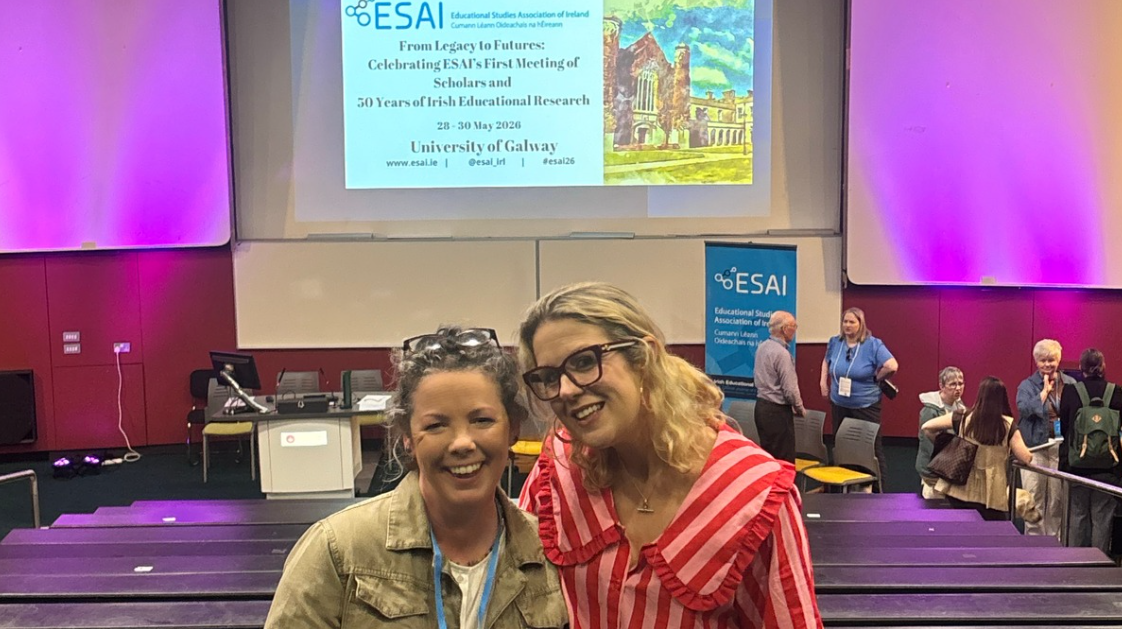
Dr Edel Ní Ghráinne presented Voices from the Refugee Classroom: How refugee learners view their ESOL provision in an Irish Context during a roundtable discussion with researchers from Dublin City University and Griffith College. The findings stemmed from a collaborative research project undertaken with Kilkenny Carlow Education and Training Board (KCETB) in partnership with colleagues from SETU’s Literacy Development Centre, Catriona Warren, Dr Lána McCarthy and Dr Caroline McGarry. The research explored refugee learners’ perspectives on English for Speakers of Other Languages (ESOL) provision in Ireland and highlighted the importance of learner voice in shaping educational practice.
Dr Caroline McGarry and Catriona Warren also presented their research, Co-Constructing Learning: A Collaborative Approach to Authentic Assessment in Teacher Education. Through a case study of innovative teaching practice, they demonstrated how engaging students in authentic, real-world assessment tasks can promote self-directed learning. Their presentation also introduced a framework for co-creating assessment with students, generating valuable discussion among delegates.
As part of the symposium Is Nature Stronger than Nurture?, Dr Zeta Dooly joined researchers from University College Dublin, Maynooth University, Dublin City University, Trinity College Dublin, Queen’s University Belfast and the Irish Society for the Study of Neurodiversity (ISSN) to present Visualising a Connected World: A Digital Learning Ecosystem at the Intersection of Nature, Technology and Education.
Her research explored education as a living, adaptive ecosystem where students, nature and emerging technologies—including generative artificial intelligence (GenAI), agentic AI and virtual reality—interact to create dynamic learning environments. The work highlighted how systems thinking and cross-disciplinary approaches can strengthen student engagement while supporting innovation in teaching and learning.
The faculty’s strong presence at ESAI 2026 reflects South East Technological University (SETU)'s continued commitment to advancing educational research that informs policy, enhances professional practice and responds to the evolving needs of learners, educators and communities. Through research spanning adult education, literacy, teacher education, digital learning and inclusion, the faculty continues to contribute to national and international conversations shaping the future of education.