

Dr Alfonso Javier Castillo Peragón
Assistant Lecturer in Spanish Language and Spanish and Latin American Literature, Art and Culture
Email: [email protected]
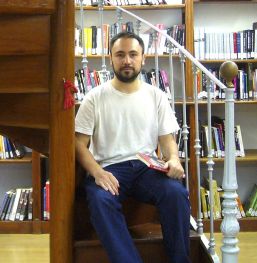

Biography
Born in Úbeda (Jaén, Spain), Alfonso Javier Castillo obtained his degree in 'Hispanic Philology' in 2009 at the University of Granada. In this first phase of his academic and working career, he studied a Master's Degree in Secondary Education at this university and worked for two years as a secondary school teacher at the Sagrada Familia Secondary School in Granada. After this period, he obtained a Master's degree in Literary Studies and Theatre (2014) and completed his PhD in Literary Theory and Spanish Literature at the University of Granada. In 2020, she carried out the reading of his PhD thesis: Hermenéutica simbólica. La poética simbólica de Juan Eduardo Cirlot. El ciclo de Bronwyn (Symbolic hermeneutics. The symbolic poetics of Juan Eduardo Cirlot. The Bronwyn cycle), which was unanimously awarded Cum Laude.
After completing his doctorate, a new stage began, characterised by the desire for internationalisation. To this end, Alfonso Castillo obtained a Master's degree in Teaching Spanish as a Foreign Language at the University of Granada. In addition, he combined his studies with teaching Spanish Literature in the Degree of 'Hispanic Philology' at the National University of Distance Education at its campus in Jaén - Úbeda (UNED, 2021-2022).
Between 2022 and 2024, Alfonso did a lectureship at the Marie Curie University of Lublin (Poland), where he taught subjects such as: Spanish for Foreigners (all levels), Spanish Literature from the 20th century to the present day, Spanish-American Literature from the 20th century to the present day and History of Spanish Art (painting and architecture), among others.
In December 2023, Alfonso Castillo made a presentation on cyberpunk literature and its development in Spain at the International Symposium 'Poéticas de la literatura en España y América Latina en el siglo XXI' ('Poetics of Literature in Spain and Latin America in the 21st Century') at the Marie Curie University. In September 2024, he made a presentation on nihilism in the poetry of Leopoldo María Panero at the International Symposium of Hispanists ‘Encuentros 2024’ at the University of Gdansk (Poland).
Since September 2024, Alfonso Castillo has been a lecturer at the South East Technological University of Waterford (Ireland). At this university he has taught Spanish for Foreigners (all levels) and has taught subjects on: Spanish-English Translation; Spanish Literature, Film and Painting; and Spanish Culture and History.
In the academic year 2024-2025, Alfonso Castillo taught the following subjects at South East Technological University:
First semester (2024-2025, at SETU):
- Advanced Spanish Translation.
- Spanish Language Reading and Writing.
- Spanish Intermediate 1 (B1.1).
- Intensive Spanish.
- Spanish in Use B1.
- Spanish Beginners 1 (A1.1).
- Spanish Upper Intermediate 1 (B2.1a).
Second semester (2024-2025, at SETU):
- Spanish Beginners 4 (A2.2).
- Spanish Beginners 2 (A1.2).
- Representations of Spain (Literature, Film, Painting and History of Spain from the 20th century to the present day).
- Spanish Language Texts and Contexts.
- Spanish in the Media.
- Spanish Upper Intermediate 4 (B2.2b).
In the academic year 2023-2024, Alfonso Castillo taught the following subjects at the Marie Curie University in Lublin:
First semester (2023-2024, at UMCS):
- Español práctico. Expresión e interacción orales. Primer curso, A1 (Practical Spanish. Oral expression and interaction. First course, A1.).
- Literatura Española de la Edad Media Renacimiento Barroco (Spanish Literature of the Middle Ages Renaissance Baroque).
- Literatura Española del Siglo XX (20th Century Spanish Literature).
Second semester (2023-2024, at UMCS):
- Español Práctico. Análisis y escritura de textos académicos. Cuarto curso, C1 (Practical Spanish. Analysis and writing of academic texts. Fourth year, C1).
- Aprendizaje práctico de una segunda lengua romance, A2 (Practical learning of a second Romance language, A2).
- Español práctico. Escritura. Primer curso, A2 (Practical Spanish. Writing. First course, A2).
- Problemas de la España contemporánea. Cultura, arte, historia y sociedad española (Problems of contemporary Spain. Spanish culture, art, history and society).
- Literatura Hispanoamericana del siglo XX a la actualidad (Spanish-American literature from the 20th century to the present day).
- Metodología de la investigación literaria. Teoría de la literatura (Methodology of literary research. Theory of literature).
In the academic year 2022-2023, Alfonso Castillo taught the following subjects at the Marie Curie University in Lublin:
First semester (2022-2023, at UMCS):
- Aprendizaje práctico de una segunda lengua romance, A2 (Practical learning of a second Romance language, A2).
- Español práctico. Expresión e interacción orales. Tercer curso, B2 (Practical Spanish. Oral expression and interaction. Third course, B2).
- Español práctico. Escritura. Tercer curso, B2 (Practical Spanish. Writing. Third course, B2).
- Literatura Española de la Edad Media Renacimiento Barroco (Spanish Literature of the Middle Ages Renaissance Baroque).
Second semester (2022-2023, at UMCS):
- Aprendizaje práctico de una segunda lengua romance, A2-B1 (Practical learning of a second Romance language, A2-B1).
- Español práctico. Escritura. Segundo curso, B1-B2 (Practical Spanish. Writing. First course, A2).
- Español práctico. Expresión e interacción orales. Tercer curso, B2-C1 (Practical Spanish. Oral expression and interaction. Third course, B2-C1).
- Español práctico. Escritura. Tercer curso, B2-C1 (Practical Spanish. Writing. Third course, B2).
- Historia del Arte Español. Arquitectura y Pintura (History of Spanish Art. Architecture and Painting).
- Español práctico. Escritura. Primer curso, A2 (Practical Spanish. Writing. First course, A2).
- Literatura Hispanoamericana del siglo XX a la actualidad (Spanish-American literature from the 20th century to the present day).
In the academic year 2021-2022, Alfonso Castillo taught the following subjects at the National University of Distance Education (Universidad Nacional de Educación a Distancia) in Úbeda, Jaén:
Second semester (2021-2022, at UNED):
- Estilística y Métrica Españolas (Spanish Stylistics and Poetic Metrics).
- Textos Literarios Españoles del Siglo de Oro (Spanish Literary Texts of the Golden Century).
- Literatura Española del Barroco (Spanish Baroque Literature).
One of Alfonso Javier Castillo's major research topics is the one he developed in his doctoral thesis: Symbolic Hermeneutics; Surrealism and Symbolism in Spanish literature from the 20th century to the present day; as well as the intermediality between literature and other arts, such as cinema, painting or photography. These general themes were developed in this doctoral thesis by studying them around the work of the poet Juan Eduardo Cirlot, with special attention to his collection of poems entitled Bronwyn. For the completion of this thesis, he carried out several research stays in Cadiz and Barcelona, as well as the publication of an article on Symbolic Hermeneutics and the poetry of Juan Eduardo Cirlot in the scientific journal RILCE (2019). In addition, he participated with presentations on this line of research in the International Congress 'Actualidad de la hermenéutica: la literatura vista por los filósofos' (‘Current affairs in hermeneutics: literature as seen by philosophers’) (University of Granada, 2016) and the International Symposium 'Ficción, conocimiento, interpretación—perspectivas interdisciplinares sobre la Poética de Aristóteles' (‘Fiction, knowledge, interpretation - interdisciplinary perspectives on Aristotle's Poetics’) (University of Navarra, 2017).
In December 2023, he collaborated in the organisation of the International Symposium 'Poéticas de la literatura en España y América Latina en el siglo XXI' (‘Poetics of literature in Spain and Latin America in the 21st century’) at the Marie Curie University, where he made a presentation on cyberpunk literature and its development in Spain. The article on which this paper is based has been accepted for publication in a joint section of academic papers of this congress to be published in the scientific journal Rilce (2026). In this work, the author analyses the general characteristics of the cyberpunk literary genre, which was born in the United States by William Gibson, and how it arrived in Spain with Rodolfo Martínez and his novel La sonrisa del gato as its pioneer, as well as its subsequent development in other Spanish literary works of the 21st century.
In September 2024, Alfonso Castillo made a presentation on another of his recent lines of research: the poetic characteristics and features of nihilism in the work of Leopoldo María Panero. This study focuses on Panero's poetry collections from the beginning of the 21st century, such as Esquizofrénicas o la balada de la lámpara azul, where nothingness appears as a state or region that is yearned for. This academic communication took place at the International Symposium of Hispanists ‘Encuentros 2024’ at the University of Gdansk (Poland).
- Lecturer in Spanish in the Department of Arts and Humanities at South East Technological University (SETU) in the academic year 2024-25. In this university, I teach subjects related to Spanish as a Foreign Language at all levels, Spanish-English Translation and Spanish Culture, Cinema and Literature (Waterford, Ireland, from September 2024 to August 2025).
- Spanish and Latin American Literature and Spanish as a Foreign Language Professor in the Hispanic Studies Degree at Marie Curie-Skłodowska University (UMCS) during the 2022-23 and 2023-24 academic years. The subjects taught correspond to these areas: Spanish Literature, Latin American Literature, Literary Theory, Teaching Spanish to Foreigners, Spanish Art History and Spanish Culture and Society (Lublin, Poland, from October 2022 to September 2024).
- Professor of Spanish Literature in the Degree of 'Hispanic Studies' at the Universidad Nacional de Educación a Distancia (UNED) during the second semester of the 2021-2022 academic year. The subjects taught have been: ‘Spanish Metrics and Stylistics’, ‘Literary Texts of the Golden Age’ and ‘Spanish Literature of the Baroque’. The classes have been in person and at the same time through the Internet. In this work experience, I have learned the skills and tools for distance learning, with the use of teaching programs on the Internet such as TEAMS and communication through forums on the UNED Campus (Úbeda, Jaén, from February 2022 to June 2022).
- Spanish Teacher for Foreigners at the Modern Languages Center of the University of Granada, where I completed the internship for the Master’s in Spanish for Foreigners. These internships involved teaching, alongside an experienced tutor, an intensive 80-hour Spanish course at a language center affiliated with the university (Granada, March 2022).
- Teacher of Spanish Language and Literature at the Sagrada Familia School, in second and third courses of ESO (Obligatory Secondary Education), first course of Bachillerato (Post-obligatory Secondary Education), second course of Bachillerato and serving as a tutor for second of Bachillerato (Granada, from January 2012 to August 2013).
- Speaker at the X International Symposium of Hispanists ‘Encuentros 2024’. Participant with the presentation titled: 'Leopoldo María Panero. El poeta como sacerdote de la nada' ('Leopoldo María Panero. The poet as a priest of nothingness’). Organised by the University of Gdańsk and the Polish Association of Hispanists. Hispanists. Date: September 25 to 27, 2024.
- Speaker and co-organizer at the conferences in the International Symposium 'Poéticas de la literatura en España y América Latina en el siglo XXI' (‘Poetics of Literature in Spain and Latin America in the 21st Century’). Participant with the presentation titled: 'El género literario del ciberpunk. La primera novela ciberpunk de autor español: La sonrisa del gato, de Rodolfo Martínez' ('The literary genre of cyberpunk. The first cyberpunk novel by a Spanish author: La sonrisa del gato, by Rodolfo Martínez’). Organized by the Department of Hispanic Studies (Katedra Hispanistyki) of Maria Curie-Skłodowska University (UMCS). Date: December 7 and 8, 2023.
- Speaker at the conferences in the International Symposium 'Ficción, conocimiento, interpretación—perspectivas interdisciplinares sobre la Poética de Aristóteles' (‘Fiction, knowledge, interpretation - interdisciplinary perspectives on Aristotle's Poetics’). Participant with the presentation titled: 'Hermenéutica simbólica. La poética simbólica de Juan Eduardo Cirlot' ('Symbolic hermeneutics. The symbolic poetics of Juan Eduardo Cirlot'). Organized by University of Navarra (Pamplona) and the Alexander von Humboldt Foundation. Date: October 26 to 28, 2017.
- Speaker at the conferences in the 'Seminario Doctoral de Investigación en Literatura, Migraciones e Interculturalidad' ('Doctoral Seminar on Research in Literature, Migrations and Interculturality'). Participant with the presentation titled 'La deshumanización como enfermedad. Sobre El cielo de Pekín de Miguel Iglesias Ortiz' (‘Dehumanization as a disease. On El cielo de Pekín by Miguel Iglesias Ortiz’). Organized by International Postgraduate School of the University of Granada. Date: April 27 and 28, 2017.
- Speaker and organization assistant at the International Congress 'Actualidad de la hermenéutica: la literatura vista por los filósofos' (‘Current affairs in hermeneutics: literature as seen by philosophers’). Participant with the presentation titled: 'Hermenéutica simbólica, mito y poesía. Luis Garagalza y Juan Eduardo Cirlot' ('Symbolic Hermeneutics, Myth, and Poetry. Luis Garagalza and Juan Eduardo Cirlot)’. Organized by Mediterranean Center of the University of Granada. Date: April 20 to 22, 2016.
- Publication of the doctoral thesis Symbolic Hermeneutics. The symbolic poetics of Juan Eduardo Cirlot. The Bronwyn cycle. ISBN: 9788413064567. University of Granada. 2020. Link: https://digibug.ugr.es/handle/10481/59944.
- Publication of the article ‘Symbolic Hermeneutics. The symbolic poetics of Juan Eduardo Cirlot’ in the scientific journal Rilce, specialized in Literature Theory and associated with the University of Navarra (Pamplona). Article acceptance date by the journal: February 9, 2018. The article is published in issue 35.1 of the RILCE journal in 2019. ISSN: 0213-2370. Link: https://doi.org/10.15581/008.35.1.223-45.