

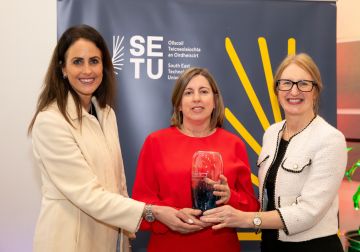
Professor Gillian Gardiner, Senior Lecturer in Microbiology at SETU, has been awarded the Established Researcher Award for her outstanding contributions to agri-food science. As the leader of a multi-disciplinary research group within the Eco-Innovation Research Centre at SETU, she has advanced research on animal feed and gut microbiome, antibiotic alternatives, and sustainable farming practices. In 2024, she was listed among the 2024 Stanford/Elsevier World’s Top 2% of Scientists.
To date, Professor Gardiner has secured over €7.4 million in research funding, establishing SETU as a key player in agricultural innovation. Professor Gardiner has developed strong national and international collaborations with universities and research institutes. She has been a member of several EU research networks, including 7th Framework (GMSAFOOD, ECO-FCE) and Horizon 2020 MSCA (MonoGutHealth) consortia and EU COST actions (PiGutNet).
Notably, Professor Gardiner recently led a SETU/Teagasc Enterprise Ireland commercialisation project, which developed a novel seaweed-derived probiotic for pigs. This probiotic offers a sustainable alternative to in-feed antibiotics, helping farmers to comply with EU regulations, while improving productivity. Administered to sows, it increases carcass weight at target slaughter age in their offspring. The probiotic is currently under an international patent application, and Professor Gardiner is liaising with companies to license the technology.
Professor Gardiner’s research has had a major impact on the pig industry. For example, as part of the EU ECO-FCE consortium, studies conducted at Teagasc Moorepark in which she played an integral part, were among the first to show how intestinal microbiota might influence feed efficiency (FE) in pigs. This led to the identification of microbial biomarkers with the potential to target improved FE, thereby reducing feed costs and environmental impact. This project was also the first to explore faecal microbiota transplantation as a tool to enhance FE in pigs. Additionally, Professor Gardiner has been involved in the development of cleaning and disinfection protocols for livestock pens and feeding systems, which are now widely used by farmers. Gillian regularly presents at industry and policymaker events and publishes popular press articles.
Beyond her research, Professor Gardiner has demonstrated strategic leadership at SETU, supervising 16 PhD students, nine postdoctoral researchers, and numerous internship and placement students to date. She has also played a key role in developing undergraduate and postgraduate courses, including flexible upskilling programmes for industry professionals.