

SETU hosted a seminar with experts from the University of Glasgow, UK, exploring AI-powered XR technologies, the Metaverse, VR learning, and innovations in Education 5.0.
Supported by the National Forum SATLE Initiative and the Teaching and Learning Centre, the event brought together leading academics to explore the crucial convergence of immersive technologies (XR/VR/AR) and Artificial Intelligence in transforming higher education.

Redefining the Learning Environment
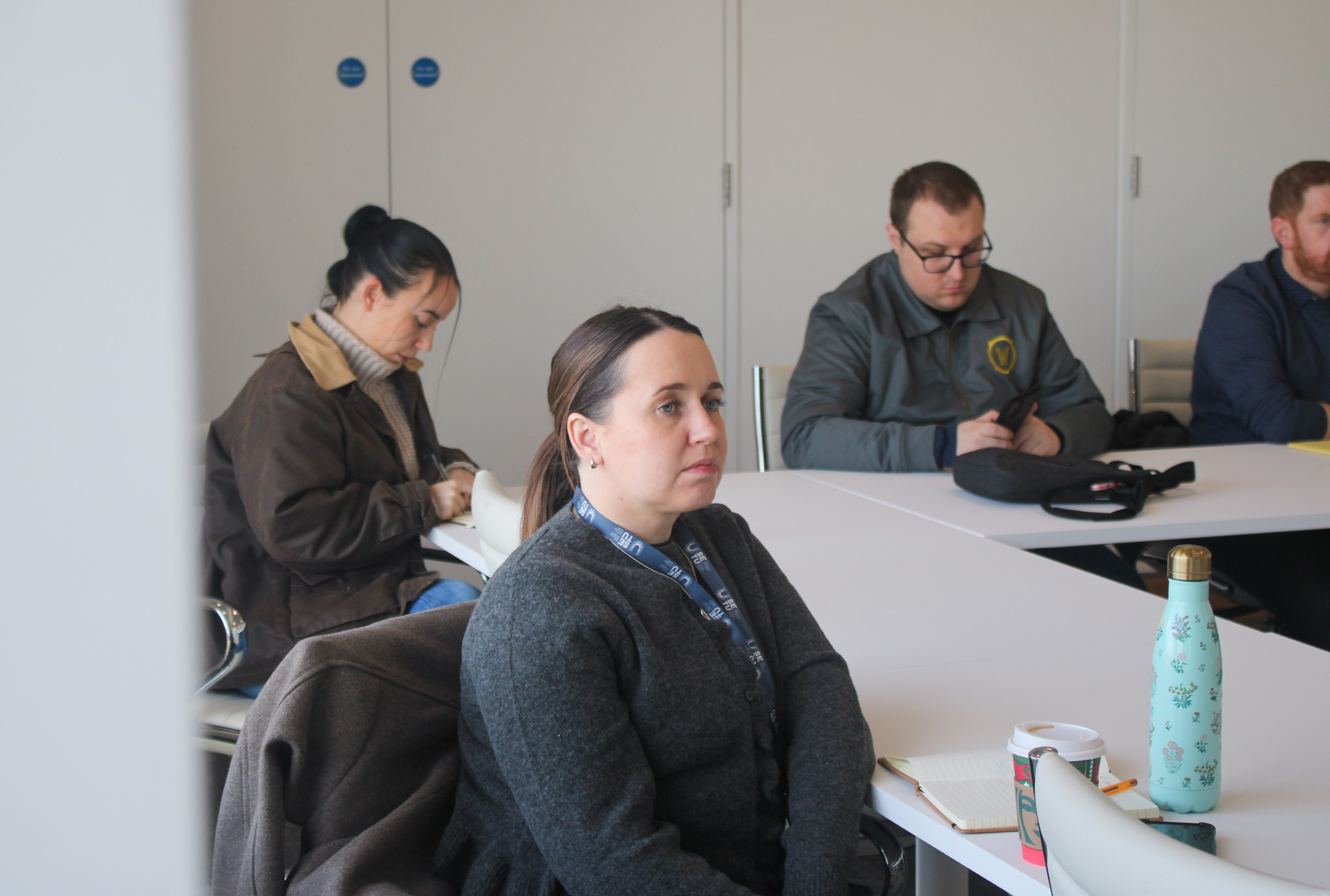
The seminar's core vision is to move beyond theory, demonstrating how these technologies create personalised, collaborative, and deeply engaging learning environments. Dr Haider Al-Juboori, Academician and Researcher at SETU opened the seminar with a short talk under title "SETU-Immersive Technologies Initiatives Brief", setting the stage for discussions on implementation and innovation within the university.

"This seminar represents a pivotal step toward Education 5.0. By converging Artificial Intelligence with immersive XR technologies, we are moving beyond theory to create adaptive, intelligent environments that fundamentally transform how students learn and collaborate."
Dr Haider Al-Juboori Academician, Faculty of Engineering and Built Environment, SETU.
Exploring the AI-Enabled Metaverse
A significant portion of the day was dedicated to exploring the architectural future of digital learning. Participants engaged with the concept of the AI-enabled Metaverse, where intelligent virtual spaces and adaptive avatars have the potential to revolutionise traditional pedagogy into fully interactive experiences.
Prof Sajjad Hussain from the University of Glasgow, UK, delivered an online presentation on the "AI-Enabled Metaverse," providing a comprehensive view of this evolving digital landscape. Following this, Prof Craig Daly, University of Glasgow, UK, bridged digital and physical realities in his online session, "From Microscope to Metaverse; Innovations in Teaching". This session specifically showcased how complex 3D scientific data can be processed for integration into animation and game engines, thereby significantly advancing science and engineering education.
VR, Connectivity, and Education 5.0
The second half of the seminar focused on the practical application and infrastructure necessary for future education.
Dr Shuja Ansari, University of Glasgow, UK, presented a crucial case study on "VR for Immersive Training: Connectivity's role in Education 5.0". This presentation highlighted the vital role of high-speed connectivity in supporting successful remote experiential learning.

The seminar concluded with a brainstorming discussion and final remarks, offering a forward-looking framework on infrastructure, scalability, and pedagogical impact for educators and researchers shaping the landscape of Education 5.0. The insights gained are essential for understanding how to leverage the convergence of AI and XR to meet the challenges of the future.
For further information, please reach out to Dr Haider Al-Juboori at [email protected].