

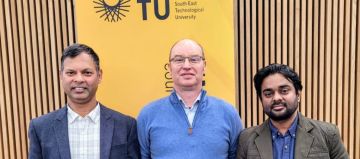
South East Technological University (SETU) researcher Dr Vibhutesh Singh has been awarded funding from the Environmental Protection Agency (EPA) Ireland for a new research project exploring how artificial intelligence (AI) can support environmental protection and regulatory compliance.
The award, valued at €161,493.51, will fund the 18-month project “F-gases and Chemicals Human-in-the-loop Artificial Intelligence Surveillance System Design” (F-CASS).
Enhancing Detection of Restricted Chemicals
F-CASS aims to improve how restricted chemicals — including F-gases — are identified in products. While widely used in sectors such as refrigeration, air conditioning, and manufacturing, F-gases are tightly regulated due to their significant impact on climate change.
The project will develop a proof-of-concept software toolkit that uses AI to analyse publicly available product descriptions and compare them with regulatory frameworks. This approach could help regulators and policymakers more efficiently identify products that may not meet environmental standards.
A central feature of the system is its privacy-by-design architecture, ensuring that only product-related information is processed in real time, with no storage of data.
Collaborative, Transdisciplinary Team
The research is supported by a transdisciplinary team bringing together expertise in environmental science, artificial intelligence, and regulatory analysis. The project team includes Dr Jai Prakash Mehta, Dr John Leslie Byrne, and Dr Vibhutesh Kumar Singh (Principal Investigator).
A Transformative Funding Boost
Commenting on the award, Dr Vibhutesh Singh said, “This funding is genuinely transformative for our work at SETU. It allows us to recruit a dedicated Postdoctoral Researcher who will play a central role in delivering the project, connecting expertise across environmental chemistry, software engineering, and chemical regulation.”
Importantly, the funding also enables co-design workshops with key stakeholders. By working directly with policymakers and regulatory professionals, we can ensure the tools we develop are grounded in real-world needs and enforcement practices.
I am deeply grateful to the EPA for recognising the potential of this research. I would also like to acknowledge my colleagues, Dr John L Byrne and Dr Jai P Mehta. F-CASS is fundamentally a collaborative effort. Our different scientific perspectives are what make this project both ambitious and scientifically robust.
Delivering Practical Tools and Policy Guidance
In the near term, our goal is to deliver a reliable proof-of-concept system alongside practical policy guidance. We want to demonstrate how AI can support — rather than replace — human expertise by providing transparent, explainable insights. Looking ahead, our broader vision is to contribute to scalable approaches for environmental assessment that can respond to evolving global supply chains and emerging regulatory challenges.”
SETU Leadership Response
Commenting on the success, Prof Marie Claire Van Hout, Vice President for Research, Innovation and Impact at SETU, said, “Funding from the Environmental Protection Agency is highly competitive and reflects the relevance and quality of research taking place at SETU. F-CASS highlights how digital technologies such as AI can be applied to pressing environmental and regulatory challenges. This project exemplifies SETU’s commitment to research that delivers meaningful societal and policy impact.”
Part of a National EPA Research Investment
The funding forms part of the EPA’s national research programme, which recently announced €6.5 million for 24 projects addressing climate and environmental challenges. The programme supports research across climate change, the natural environment, the green and circular economy, and environment and human health.
This award further strengthens SETU’s expanding research activity at the intersection of artificial intelligence, sustainability, and regulatory innovation.