

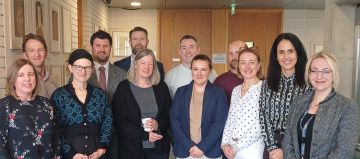
Ten academics from South East Technological University (SETU) have successfully secured TU RISE-funded Sabbaticals, enabling them to dedicate twelve months to exclusively advancing high-impact research projects in collaboration with regional enterprise partners.
The initiative forms part of SETU’s commitment to strengthening research capacity and deepening engagement with industry across the south east region through the TU RISE programme.
The sabbaticals will provide the academics with protected time away from teaching responsibilities, allowing them to focus fully on research activity, innovation, and collaboration with enterprise partners. Each project supported under the scheme includes a dedicated industry collaboration, ensuring the research addresses real-world challenges and opportunities relevant to regional economic and societal development.
This latest tranche of TU RISE Sabbaticals builds on the continued success of the scheme in supporting researchers across SETU to develop impactful research programmes, strengthen enterprise partnerships, and enhance the university’s research and innovation capacity.
The TU RISE Sabbatical Scheme is designed to support experienced researchers to further develop their expertise, build strategic partnerships, and generate impactful outcomes for industry and the wider community.
Prof Marie Claire Van Hout, Vice President for Research, Innovation and Impact at SETU, said “The TU RISE Sabbatical Scheme is an important investment in our research community and in the future growth of research and innovation capacity at SETU. By providing dedicated time for focused research activity and collaboration with enterprise partners, these sabbaticals will help deliver impactful research that responds directly to regional needs and opportunities.”
The TU RISE programme supports the development of research and innovation capacity within the technological university sector, with a strong emphasis on regional engagement, enterprise collaboration, and delivering impact through applied research. Details of each project can be found below.
TU RISE is co-financed by the Government of Ireland and the European Union through the ERDF Southern, Eastern & Midland Regional Programme 2021–27 and the Northern & Western Regional Programme 2021–27.

Dr Tuite is a Lecturer in Management and a Researcher in SETU School of Business with a background in Sociology, Business and Engineering.
Her research is centred on organisation studies with a particular interest in labour market experiences transformations of work and the experiences of unemployment, primarily through an STS/ANT perspective. I employ ethnographic, biographical narrative and storytelling methods when collecting data.
Her TU RISE Sabbatical will focus on a project entitled 'An investigation of the conditions for successful engagement in Equality, Diversity and Inclusion (EDI) programmes for women in the Pharmaceutical Industry'. An industry partner for this project is Eirgen Pharma.
Dr Davy is Head of the Department of Computing and Mathematics at SETU, and
His research interests are in Fixed and Wireless Network Management, Software Defined Infrastructure, Internet of Things, Fog and Edge Computing, Bio-inspired systems, and Molecular / Nano-scale communications and TeraHertz Communication
His TU RISE Sabbatical will focus on a project entitled 'Energy-Aware Trust-based Routing for LLM Agents on Enterprise Edge Platforms'. This research sabbatical will be hosted in collaboration with IBM Waterford.
Dr O' Meara is a Lecturer in Molecular Biology at South East Technological University (SETU) and a member of the Molecular Ecology Research Group (MERG) within the Eco-Innovation Research Centre (EIRC).
Her research focuses on applied molecular ecology, using DNA-based technologies to address challenges in wildlife conservation, vector surveillance, environmental health, and agricultural sustainability.
Her TU RISE Sabbatical will focus on a project entitled 'Applied Molecular Ecology for Biodiversity Monitoring: From Research Innovation to Operational Practice'. Industry partner for this project is Waterford City and County Council (WCCC) Heritage and Environment Department.
Professor Gardiner is a senior lecturer in microbiology in the Department of Land Sciences at SETU.
Her research looks into alternatives to antibiotics for animals and humans (probiotics, prebiotics, etc), microbiome (pig gut, animal feed, anaerobic digesters), biosafety of manure recycling, novel antimicrobials (from marine and other sources), and foodborne pathogens (e.g. Salmonella carriage in pigs).
Most recently, Professor Gardiner has been appointed to the Food Safety Authority of Ireland (FSAI) Scientific Committee, where she will contribute expert scientific advice on food safety and nutrition to support public health and food safety policy.
Her TU RISE Sabbatical research will look into the assessment of seaweed-derived Bacillus for sustainable crop applications. Industry partners for this project include Ashleigh Farms, Dungarvan, Kerry Group, BIO-CAT Microbials, Teagasc Moorepark, and Technological University of the Shannon, Athlone.
Hazel Peavoy is the Principal Investigator for ENTIRE, a European Digital Innovation Hub (EDIH), part of a network of over 250 hubs supporting the digital transformation of SMEs and public sector organisations across Europe. She is also Senior Strategic Business Partner at the Walton Institute, where she works closely with stakeholders in the agri-food sector across Ireland and Europe to advance the application of digital technologies and innovation.
Hazel has extensive experience leading European and national research initiatives focused on digital innovation, smart agriculture, and regional development. Her previous roles include Site Manager for VistaMilk, Project Manager for CITIES2030, and Regional Cluster Lead for Smart Agri Hubs and AgROBOFood.
Her TU RISE Sabbatical research will focus on a project entitled 'How European Digital Innovation Hubs Shape Regional Innovation Outcomes'. Industry partners for this project include Walton Institute, the Southern Regional Assembly (Ireland), ENTIRE EDIH (Ireland), DATALife (Spain), EDIH Bretagne and Bretagne NEXT (France), and Axencia Galega de Innovación (Spain).
Laurence Fitzhenry is Head of the Faculty of Science & Computing (Waterford) at SETU and Principal Investigator of the Ocular Therapeutics Research Group (OTRG) at the Pharmaceutical & Molecular Biotechnology Research Centre PMBRC. His research focuses on ocular drug delivery, polymer science, nanomedicine, and the development of patient-centred therapies for eye disease.
Dr Fitzhenry has secured more than €10 million in national and European research funding and has led major collaborative initiatives, including the MSCA-ITN ORBITAL programme and the MSCA-COFUND INNOVISION project. His research group develops advanced nanoformulations and drug delivery systems for anterior and posterior eye diseases, with a strong emphasis on translational research, innovation, and commercialisation.
His TU RISE Sabbatical research will focus on expanding OcuDel Ltd., a SETU spin-out developing novel ocular therapeutics for companion animals, into the human health market. An industry partner for this project is OcuDel Ltd.
Dr Owen Naughton is a Lecturer in Environmental Engineering at SETU Carlow. His research focuses on hydrology, ecosystem science, remote sensing, and the impacts of environmental change on natural systems.
Dr Owen Naughton's research uses environmental observation, field analysis, modelling, and remote sensing techniques to better understand ecosystem function and resilience to climate change. His work is strongly linked to the implementation of major European environmental policies, including the EU Habitats and Floods, and Water Framework Directives.
His TU RISE Sabbatical research will focus on a project entitled 'Mapping Storm-Induced Forest Change Using Airborne LiDAR'. Industry partners for this project include the SETU National Aerospace Academy, Applied Aerial Technology (AAT), and Waterford Airport.
Dr Paula Carroll is a Co-Course Leader of the Master's in Advanced Facilitation Skills for Health and Well-Being at SETU, where she has lectured on undergraduate and postgraduate programmes since 2003. Her research focuses on health promotion, facilitation skills, emotional intelligence, learning in the affective domain, and men's health
Dr Carroll previously worked with the HSE in the area of men's health policy and health promotion research, and was co-author of the world's first National Men's Health Policy and the subsequent National Men’s Health Action Plan. She is also a member of the Centre for Health Behaviour Research Group at SETU and has extensive experience supervising postgraduate research students and developing national health promotion training initiatives.
Her TU RISE Sabbatical will focus on a project entitled 'Assessing ‘Readiness’ for Replicating a Community-Based Men’s Health Initiative via Implementation Science Frameworks'. Industry partners for this project include Waterford Local Sports Partnership.
Dr Richard Bolger has lectured in the Department of Sport & Exercise Science at SETU since 2005 across a range of undergraduate and postgraduate programmes. He completed his PhD at the University of Limerick, where his research focused on the biomechanics and movement specificity of resistance training in elite athletes.
Dr Bolger's interests include strength and conditioning, biomechanics, sports psychology, and the use of artificial intelligence in sports performance analysis.
His TU RISE Sabbatical will focus on a project entitled 'Developing a Regional Model for Coach Education, Performance Support, and Event Hosting in an Emerging Combat Sport'. Industry partners for this project include Jiu Jitsu Ireland (NGB) and Ganbaru Jiu Jitsu Academy, Waterford.
Dr Zeta Dooly is a lecturer in the School of Education and Lifelong Learning at SETU and Course Director for the Postgraduate Certificate in Technology Enhanced Learning. Her research focuses on technology-enhanced learning, digital education, ethical algorithms, Recognition of Prior Learning (RPL), and the use of emerging technologies such as AI, AR, VR, and MR in education.
Zeta previously worked with the Walton Institute (TSSG), where she contributed to several European and nationally funded cybersecurity and digital innovation projects. She was also nominated for both the Teaching Excellence Award and the SETU Early Career Researcher Award.
Her TU RISE Sabbatical will focus on a project entitled 'Embedding Emerging Technologies in Education Practice and Policy: An Applied Research and Knowledge Exchange Programme'. Industry partners for this project include Ard Scoil Na Mara, Tramore; Fenor National School, Co. Waterford; Waterford Education Centre; the Department of Education and Youth, Ireland; and the Joint Research Council, Belgium.