South East Technological University marked 2025 as a year of significant progress in research, innovation and impact.
Across disciplines and campuses, SETU researchers, students and partners drove new discoveries, secured competitive funding, and strengthened regional and global collaborations.
January–March: major partnerships, health impact and global collaboration.
SETU began the year with a major industry partnership as researchers joined forces with FLI Global on a groundbreaking project for the cement industry, advancing low-carbon innovation. In health research, SETU experts helped shape Ireland’s national approach to physical activity for cancer patients, and the university secured substantial funding from Ireland's Health Research Board (HRB) to scale a successful community-based men’s health initiative.
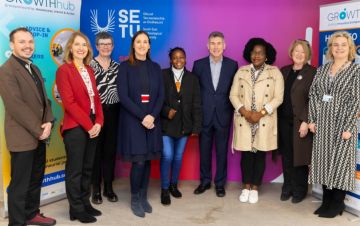
In February, SETU strengthened its position in sustainability research by securing $1.37 million under the US-Ireland R&D Partnership for a new bioplastics project, while SETU spin-out Supplement Certified also achieved a milestone by securing High Potential Startup funding.
March brought advances in innovation and international engagement. Dr Lee Coffey received a US patent for an innovative liquid-handling device, and SETU hosted a major aerospace showcase highlighting industry collaboration and world-class training.
The University also partnered with Rovuma University in Mozambique on entrepreneurship development and deepened its global engagement by hosting partners from Ireland and Ethiopia as part of the Building Resilience Through Education (BRTE) programme.
April–June: European leadership, strategy launch and high-impact publications
In April, SETU received €3.1 million under the Innovision COFUND programme to support research in vision and sight loss. SETU also played a leading role in Greensphere, a national initiative advancing sustainable AI, and secured further international funding for rare disease gene therapy research.
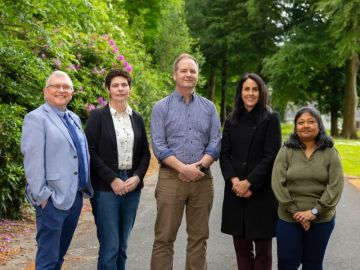
May marked an important milestone with confirmation that SETU continues to lead Ireland’s technological universities in Horizon Europe funding. SETU students continued to excel, including a top award from the Irish Plant Scientists Association.
In June, SETU celebrated ten years of collaboration with African universities and SETU researcher Dr Evan Matthews contributed to a Lancet Psychiatry report.
June also saw the University launch its new Research Strategy, setting the direction for research, innovation and impact to 2028.
July–September: rural innovation, global recognition and digital support for SMEs
July highlighted SETU’s commitment to regional development with the opening of the EXIT4 Rural Innovation Hub in Urlingford, and strengthened regional enterprise support through a partnership with Dungarvan Enterprise Centre.
SETU Vice President for Research, Innovation and Impact, Professor Marie Claire Van Hout published a Lancet Viewpoint on the care of women in prison, and SETU announced the winners of its Research Impact Case Study competition, while a landmark national men’s health report co-authored by two SETU researchers was also published.
In August, an SETU student won a national award for an eco-driven business pitch. The University also collaborated with the University of South Dakota on biomedical electronics opportunities.
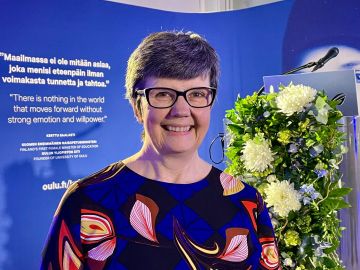
September brought global recognition as five SETU researchers were named among the world’s top 2% of scientists while SETU Professor Felicity Kelliher was awarded the prestigious Kerttu Saalasti Award for 2025 in Finland.
October–November: postgraduate excellence and AI innovation
October saw SETU confer a record number of PhD graduates, underscoring the university’s growing strength in postgraduate research training. In addition, SETU researcher Dr Laurence Fitzhenry, Head of School of Science and Computing, secured international patents for breakthrough eye-drop technology, and the University launched Elevate, a digital resource providing practical supports for micro-enterprises. Notably, two SETU projects also secured Enterprise Ireland Commercialisation funding, totalling €1.1 million.

In November, Walton Insitute at SETU launched Q-FENCE; a €5.3 million Horizon Europe project, while BRIM-RIKON Research Centre welcomed SEALabHaus project partners to Waterford for the fifth SEALabHaus Transnational Forum, highlighting regional expertise and the south east’s coastal heritage.
Rounding off the year, SETU secured Enterprise Ireland funding for an AI-driven solution to enhance compliance with the Common Agricultural Policy in December, demonstrating SETU’s leadership in applying AI to national and regional priorities, while SETU and Makerere University advanced smart portable water purification innovation, and celebrated World Soil Day with a series of videos featuring researchers from SETU's Department of Land Sciences.
A year defined by impact
Throughout 2025, SETU advanced its position as a leading research-engaged university. The year demonstrated clear progress: sustained excellence in Horizon Europe, impactful publications including several in The Lancet, major national and international funding wins, new patents, growth in spin-outs, and strong engagement with enterprises and communities.
As SETU looks toward 2026, the University is building on this momentum to deepen partnerships, strengthen research capacity and continue delivering solutions that benefit the south east region, Ireland and global society.
This carousel shows images from a variety of news that we shared in 2025;