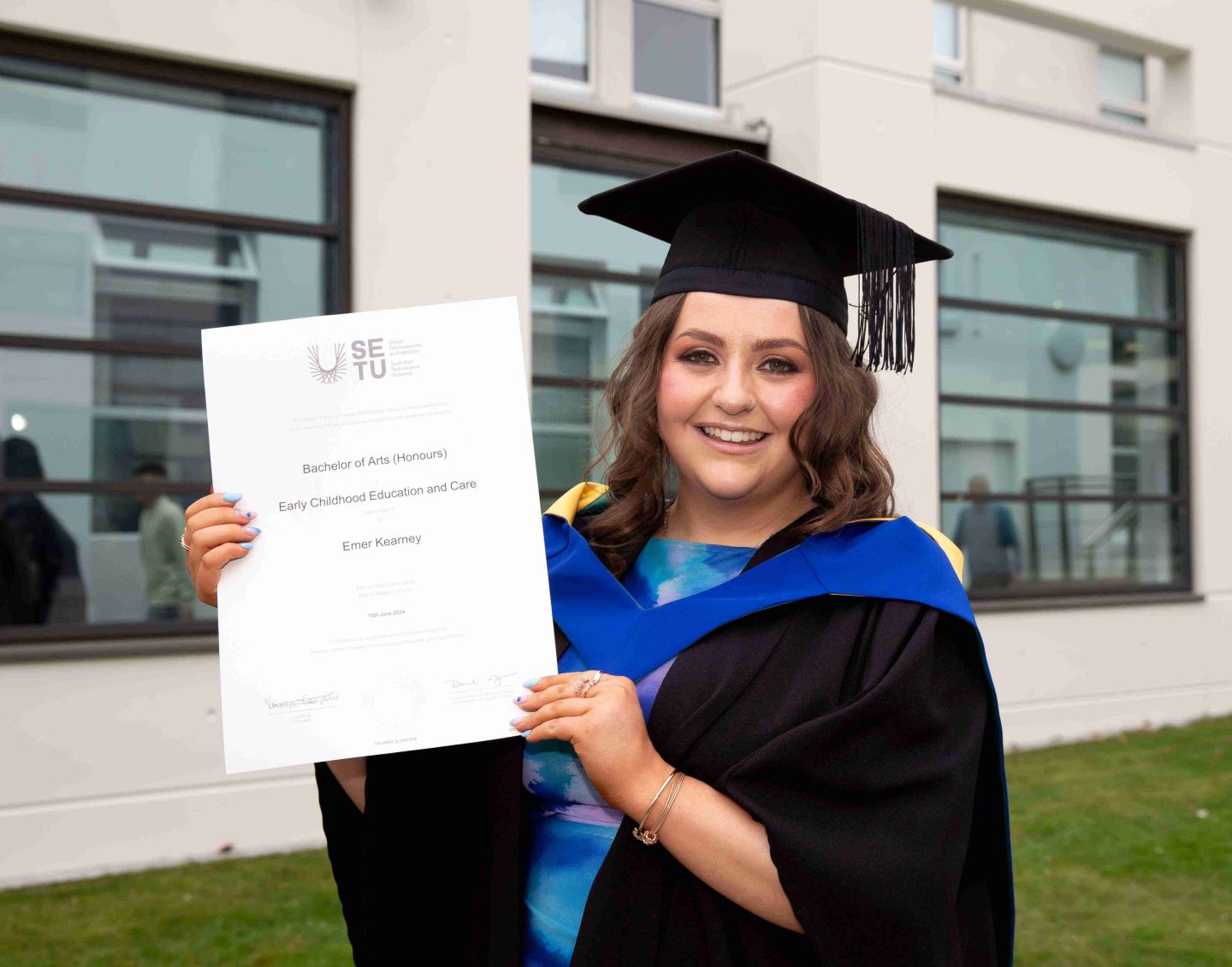
The Bachelor of Education (Honours) in Early Childhood Education and Practice is a four-year Level 8 degree designed for early years professionals who wish to gain a recognised qualification while developing their knowledge, skills and professional practice.
The programme explores child development, education, psychology, sociology, inclusion, play-based learning, leadership and professional practice, preparing graduates to support children's learning, development and wellbeing within a range of early childhood settings.
A distinctive feature of the programme is its strong emphasis on professional practice. Learners complete over 900 hours of supervised placement and practice-based learning, enabling them to connect theory with real-world early childhood education and care environments.
Funding and Eligibility
his programme is eligible for the Nurturing Skills Learner Fund (NSLF) for the 2026/27 academic year. The fund supports early years educators working in Core Funding partner services to undertake approved Early Learning and Care qualifications while continuing to work in the sector.
The initiative forms part of the Government's commitment to achieving a graduate-led Early Learning and Care workforce and supports eligible learners with the costs associated with studying at Levels 7 and 8.
Full eligibility criteria and application information are available at gov.ie
From March 2026, new applicants should contact [email protected] to request access to the NSLF Student Portal and complete the application process. Applicants who have previously applied and were unsuccessful must submit a new application for the 2026/27 academic year.
What you will learn
The programme provides a broad understanding of early childhood education and practice, combining academic study with extensive professional experience.
You will examine child development, psychology, sociology and pedagogy, while exploring topics such as children's rights, health and wellbeing, diversity and inclusion, language development, creative arts, STEM education and professional practice. The programme is grounded in national frameworks including Aistear and Síolta, supporting learners to create inclusive, child-centred learning environments.
As you progress through the programme, you will develop expertise in areas such as educational needs, regulation and inspection, children's law, leadership, family and community engagement, and supervision and mentorship. In the final year, learners undertake an independent research project, developing their ability to critically evaluate issues and evidence within the sector.
Professional practice is embedded throughout the programme, allowing learners to apply their learning in early childhood settings and develop the knowledge, skills and professional confidence required for graduate-level practice.
Flexible pathways and exit awards
Year 1 (60 Credits) Certificate in Education: Introduction to Early Childhood Studies (Level 6)
Year 2 (120 Credits) Higher Certificate in Education in Early Childhood Education and Practice (Level 6)
Year 3 (180 Credits) Bachelor of Education in Early Childhood Education and Practice (Level 7)
Year 4 (240 Credits) Bachelor of Education (Honours) in Early Childhood Education and Practice (Level 8)
Delivery
This programme is designed with flexibility in mind, recognising that many students are balancing study with work and family commitments.
Years 1 and 2 — Blended Learning In your first two years, the programme is delivered in a blended format. Some weeks you will attend on campus at SETU and on the remaining weeks you will engage with your studies online. This gives you the best of both worlds — the flexibility of online learning combined with valuable face-to-face time to build relationships with your lecturers and classmates that will support you throughout your studies and beyond.
Years 3 and 4 — Fully Online In your third and fourth years, the programme moves to fully online delivery, giving you maximum flexibility as you advance your studies and professional practice.
Please note: Any module that includes an end of module formal examination will require you to attend your campus in person to sit that exam.
Academic Writing and Enquiry in Higher Education
Introduction to Sociology
Creative Arts Practice in Early Childhood
Introduction to Psychology
Early Childhood Education and Practice
Play-based Pedagogy
Introduction to Children’s Social Policy
Children’s Health, Care and Wellbeing
Child Development
Supervised Professional Practice 2
Language and Multilingualism in Early Childhood Practice
Diversity and Inclusion
School Age Childcare Practice
Creative Arts Practice for School Aged Children
The Psychology and Sociology of Children & Childhoods
Critical Perspectives on Children’s Health and Wellbeing
Regulation and Inspection in Early Childhood Education
STEM Curriculum for Early Childhood and After-school Education
Law for Early Childhood Practice
Advanced Pedagogical Practices
Educational Needs
Supervised Professional Practice 3
All applicants will be considered on a case-by-case basis. Lifelong Learning reserves the right to require applicants to attend for an interview to determine their suitability for the course. Students who hold an NFQ Level 6 qualification in Early Childhood Education may also be eligible for advanced entry to Year 2 of the programme.
Ideally, applicants should currently be employed in an Early Childhood setting.
NB: Because this course must undertake Supervised Professional Placement that will bring students into contact with children and vulnerable adults, SETU is committed to ensuring that only suitable candidates are allowed to undertake these courses. SETU uses the Garda Central Vetting Unit (GCVU) vetting service to assess the suitability of all applicants. Therefore, offers on this course are conditional and could subsequently be withdrawn if applicants do not meet the Garda Vetting requirements. In year 1, work based learners must complete a minimum of 120 professional Placement hours in Semester 2. In year 2, work based learners must complete a minimum of 265 hours of supervised professional practice. In year 3, work based learners must complete a minimum of 265 hours of supervised professional practice
Career Opportunities Graduates will have the knowledge, competencies and skills to work directly with, or on behalf of, babies and young children in a range of early childhood settings, particularly in the ECCE ‘free’ pre-school year funded by the Department of Children and Youth Affairs. Professional employment opportunities can include roles as room leaders, managers and leaders in early childhood settings such as: pre-schools; crèches; special needs services; family support centres and community services. Opportunities may include leadership roles in county childhood care committees, specialists with Better Start National Early Years Quality Development, or inspectors with the Department of Education and Skills.
Further Studies Graduates have gone on to pursue master’s qualifications in speech and language therapy; primary school teaching; play therapy; Montessori education; applied behaviour analysis; child, family and youth studies; and further education studies (leading to registration with the Teaching Council). Graduates are eligible to apply to progress onto the Masters in Leadership in Early Years Education and Care or research masters through socialCORE at South East Technological University