

SETU Education for Sustainable Development Framework
The SETU Education for Sustainable Development (ESD) Framework supports the integration of sustainability across teaching, learning, assessment and the wider student experience. It provides a shared approach for embedding sustainability within programmes, modules and learning activities, enabling students to develop the knowledge, skills, values and agency needed to contribute to sustainable development and help shape more sustainable and just futures.
The framework aligns with UNESCO’s Education for Sustainable Development for 2030 Roadmap, Ireland’s Second National Strategy on Education for Sustainable Development to 2030, the United Nations Sustainable Development Goals (SDGs), and guidance from QAA and Advance HE.
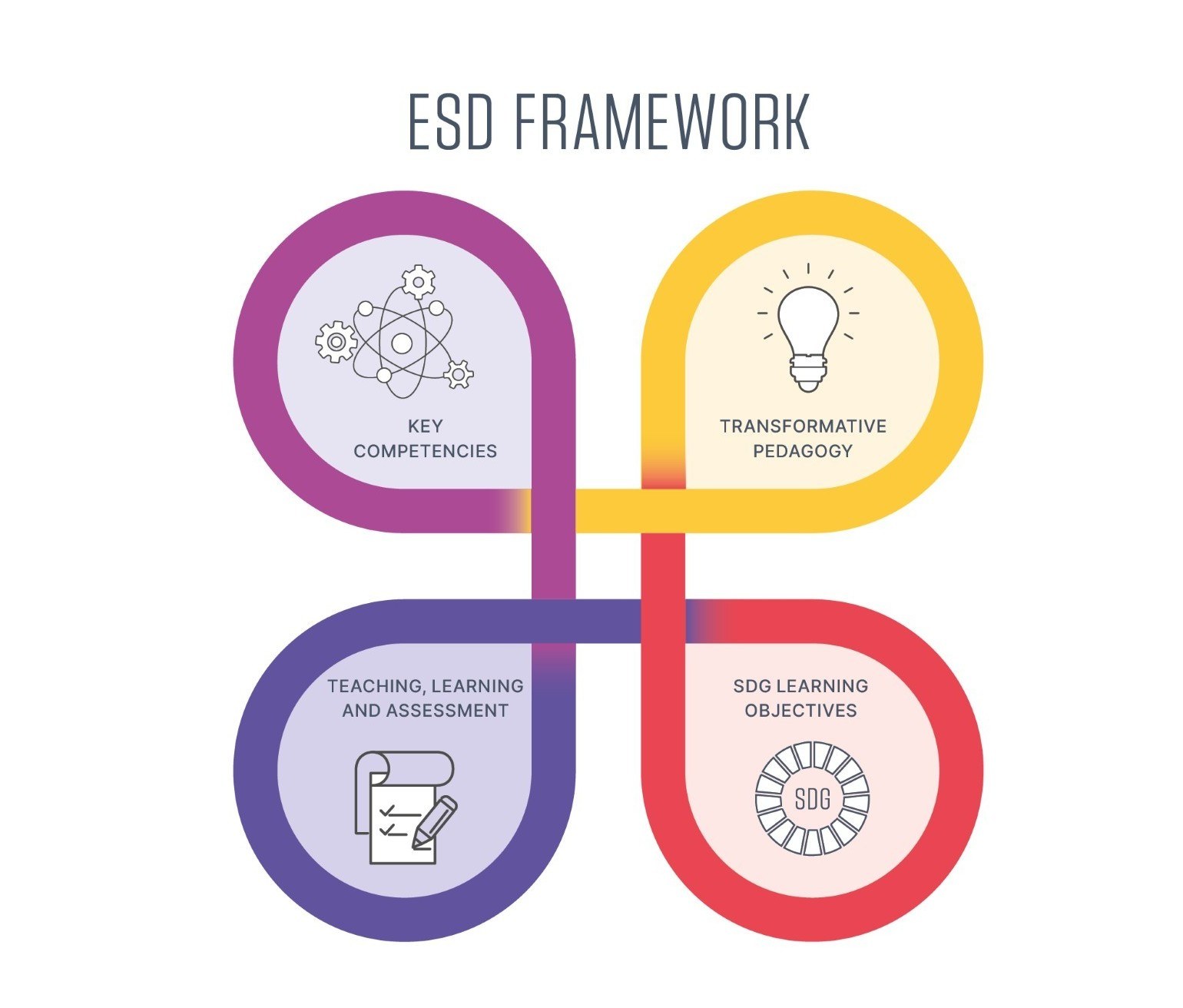
(Framework developed with reference to UNESCO ESD guidance, the Trinity College Dublin ESD Curriculum Framework, and informed by SETU student feedback and co-design processes.)
Why this approach?
Education for Sustainable Development equips learners with the knowledge, competencies, values and attitudes needed to address complex sustainability challenges and contribute to a more sustainable future. It supports learners in understanding the interconnected environmental, social, cultural and economic dimensions of sustainable development and their relevance to disciplines, professions and communities.
UNESCO highlights the importance of transformative learning approaches that encourage critical thinking, systems thinking, collaboration, participation and action. ESD enables learners not only to understand sustainability challenges but also to reflect on their own roles and responsibilities and to take informed action individually and collectively.
Student feedback at SETU reflected these priorities, emphasising:
“Bring ESD from the first year to last year of college education, so students have the chance to process the information and build up over time a stronger mindset on the field.”
“It is important to have real life examples of sustainability on each module, in order for students to get more familiar with the topic and to enhance the creativity/mindset around it.”
“Each course should have a focus on ESD for the specific path (science, accounting…) but also bring together each path to get a stronger connection and a broader image. See how these changes can be applied thanks to connections of different disciplines.”
“Bring into courses ways/skills that are possible to make an action for students, instead of just educating them on what is not working.”
“There should also be more workshops that include students, staff and lecturers from different modules to come together to drive change.”
“By having more sustainable mindset in day-to-day college life and how we go about things to make it a better place for years to come.”
The framework is organised around four interconnected dimensions that support the integration of sustainability across curriculum design, teaching, learning and assessment:
- SDG Aligned Learning Objectives
- ESD Competencies
- Pedagogical Approaches
- Teaching, Learning and Assessment Strategies
Drawing on UNESCO guidance and SDG Learning Objectives, the framework supports constructive alignment between learning outcomes, learning activities and assessment.
Together, these dimensions provide a structure for embedding Education for Sustainable Development across curriculum design, teaching, learning and assessment.

Further Support
The SETU ESD Framework is designed to support staff in embedding sustainability meaningfully across teaching, learning and the wider student experience.
Guidance materials, curriculum tools, case studies and practical resources are available through the ESD Resource Hub.
Staff can also contact the ESD team to arrange workshops, programme discussions, curriculum development support or presentations on Education for Sustainable Development.
References
- UNESCO (2017). Education for Sustainable Development Goals: Learning Objectives. Paris: UNESCO.
- UNESCO (2020). Education for Sustainable Development: A Roadmap (ESD for 2030). Paris: UNESCO.
- UNESCO (2021). ESD for 2030 Framework. Paris: UNESCO.
- Department of Further and Higher Education, Research, Innovation and Science (DFHERIS) (2022). National Strategy on Education for Sustainable Development to 2030. Government of Ireland.
- United Nations (2015). Transforming our World: The 2030 Agenda for Sustainable Development. New York: United Nations.
- Wiek, A., Withycombe, L., & Redman, C. (2011). Key competencies in sustainability: a reference framework for academic program development. Sustainability Science, 6(2), 203–218.
- QAA and Advance HE (2021). Education for Sustainable Development Guidance. The Quality Assurance Agency for Higher Education, UK.
- Sterling, S. (2010). Learning for resilience, or the resilient learner? Towards a necessary reconciliation in a paradigm of sustainable education. Environmental Education Research, 16(5–6), 511–528.
- Tilbury, D. (2011). Education for Sustainable Development: An Expert Review of Processes and Learning. UNESCO.
- Geels, F. W., & Schot, J. (2007). Typology of sociotechnical transition pathways. Research Policy, 36(3), 399–417.