

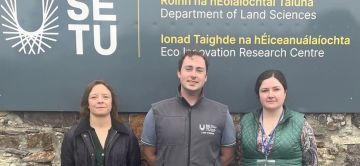
Researchers at South East Technological University (SETU) are investigating how soil structure influences phosphorus availability and loss, generating new insights that could help safeguard crop yields and protect the environment.
The work is led by SETU PhD researcher Patricia Roche, supported by Dr Sara Vero, Dr John Cleary, Dr Samuel Browett (all SETU), and Dr Mary Harty (University College Dublin).
Patricia explained why this research is important; "What’s promising about this research is that farmers can actively improve soil structure through management practices, enhancing how efficiently plants use phosphorus while reducing the risk of loss to waterways."
The challenge of phosphorus
Phosphorus is essential for plant growth, yet it behaves in complex ways within the soil. Too little limits agricultural productivity; too much contributes to water pollution, harmful algal blooms, and ecosystem damage. According to the Environmental Protection Agency (EPA), phosphate concentrations remain too high in 28% of rivers and 32% of lakes in Ireland.
Compounding the challenge, phosphorus fertilisers are derived from finite rock reserves. The European Union imports more than half of its phosphorus supply, primarily from Morocco, making the bloc vulnerable to supply pressures and global price fluctuations. Recognising this scarcity, the European Commission designated phosphate rock as a Critical Raw Material in 2014.
Bridging soil physics, chemistry and microbiology
Patricia's research investigates how soil structure affects the accessibility of phosphorus to plants and the likelihood of phosphorus loss through runoff. Soil structure can be modified through farm management practices, offering a realistic route to improving nutrient use efficiency and protecting water quality.
Dr Sara Vero added, “Traditional phosphorus management has focused on soil chemistry. This project brings together physics, chemistry, and microbiology to understand the full picture.”
This collaborative PhD project is supported by SETU Department of Land Sciences and the UCD College of Engineering and Architecture.

Research work to date
To explore the dynamics of phosphorus in structured and compacted soils, the research team conducted a multi-year pot trial examining phosphorus build-up and draw-down across varying levels of soil compaction. Microbial community analysis — including both bacterial and fungal populations — is underway to assess how these microorganisms interact with soil chemistry and influence nutrient supply in grassland systems.
A controlled runoff trial also tested how differing forms of runoff generation affect phosphorus loss. While both runoff types resulted in similar loss patterns, compacted soils produced significantly greater phosphorus losses, underscoring the importance of maintaining healthy soil structure for both productivity and environmental protection.
Patricia explains, in detail, how the pot trial is undertaken, in this video.
The data from this research, currently under review, will help address a major knowledge gap in the agri-environment and support evidence-based recommendations for sustainable soil and nutrient management.
This PhD research project is funded through the South East Regional Development Fund (SERD).