
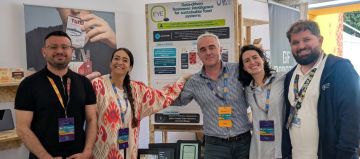
An award-winning artificial intelligence (AI) technology developed at South East Technological University (SETU), which could help transform how food quality is assessed and reduce waste across the global food supply chain, has been showcased at a major United Nations event in Rome.
Researchers from SETU's Department of Land Sciences presented their innovative Eye-Q technology at the Food and Agriculture Organization (FAO) of the United Nations' ‘From Seeds to Foods’ Global Exhibition, held at Circo Massimo in Rome, Italy.
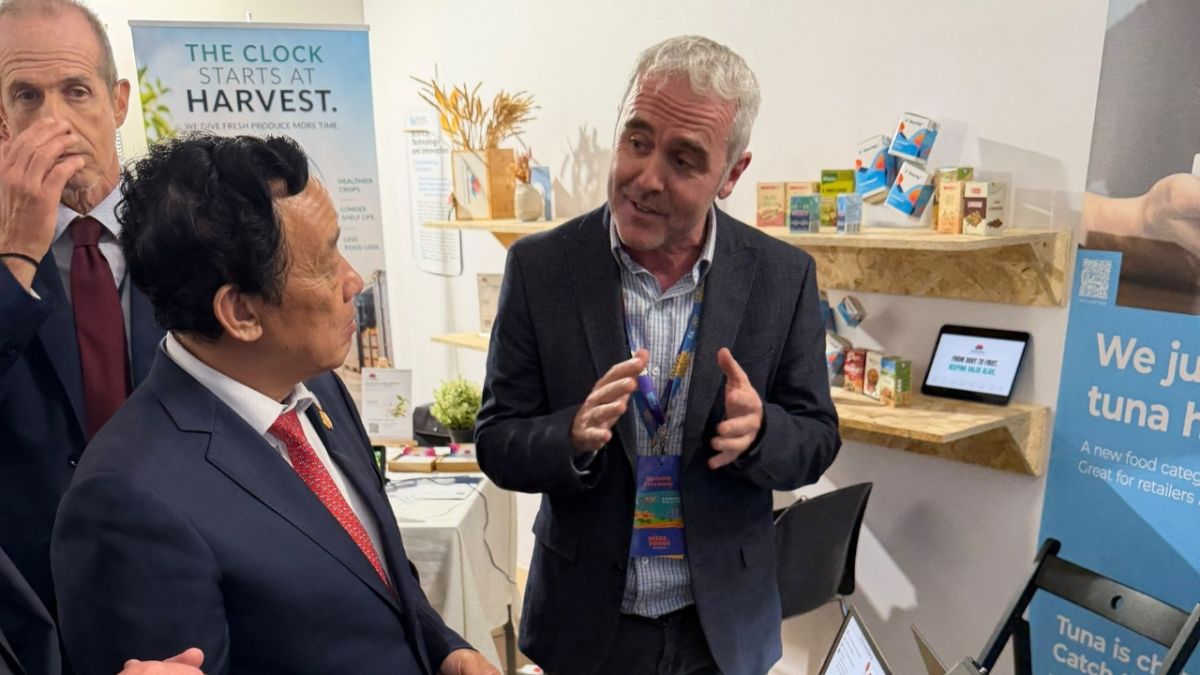
During the event, the SETU team had the opportunity to demonstrate the technology to FAO Director-General Dr Qu Dongyu, highlighting how research-led innovation can contribute to more sustainable and resilient food systems.
The international exhibition brought together technological innovations, research and expertise from around the world, demonstrating how new approaches can strengthen food security, improve nutrition and support sustainability.
A smarter approach to reducing food waste
Developed by researchers at SETU, Eye-Q is an AI-powered digital solution designed to assess the quality of fresh produce and predict how much shelf life remains, helping businesses make better-informed decisions about how food is stored, distributed, sold and used.
Unlike solutions that require additional sensors or specialist equipment, Eye-Q is being developed as a downloadable digital system that can operate without additional infrastructure investment. This could make the technology more accessible to businesses throughout the food supply chain, from producers and distributors to retailers.
By providing product-specific information about food quality and remaining shelf life, Eye-Q aims to help prevent unnecessary waste before it occurs, while also identifying opportunities to recover value from produce that might otherwise be discarded.
The technology has already received significant European recognition, winning the Best Market Discovery Prize in the 'Fair & Resilient Food System Mission' at the European Institute of Innovation and Technology (EIT) Food Seedbed Incubator Programme.
For Dr Ultan McCarthy of SETU's Department of Land Sciences, the opportunity to present Eye-Q at the FAO exhibition marked an important milestone in the technology's development.
"Food waste is a major global challenge, and Eye-Q offers a new way of addressing it," he said. "By using AI to predict the remaining shelf life of fresh produce, without requiring additional sensors or costly infrastructure, we're developing a solution that could make a real difference for businesses and consumers."
Demonstrating the technology to the Director-General of the FAO was a particularly significant moment for the team, Dr McCarthy explained, providing an opportunity to highlight how research developed at SETU could contribute to more sustainable food systems worldwide.
The researchers are currently developing Eye-Q models for a wider range of food products and scaling the application towards commercial deployment. The project is also seeking to engage with individuals and organisations with expertise in international agri-food systems to explore future commercial opportunities.
Supporting research with commercial potential
The Eye-Q research team comprises Dr Ultan McCarthy, Dr Anastasia Ktenioudaki, Dr Yuanyuan Pu, Dr Carlos Esquerre and Ms Federica Femiano, all based in SETU's Department of Land Sciences.
The development of Eye-Q is supported by Enterprise Ireland through its Commercialisation Fund Programme (project CF-2024-2360-A).
SETU's Technology Transfer Office (TTO) played an important role in supporting the research team to develop their funding application and successfully secure the Enterprise Ireland investment needed to advance the technology.
Dr James O'Sullivan, Head of Innovation and Commercialisation at SETU, described Eye-Q as an example of how university research can respond to challenges facing industry and society.
"Our Technology Transfer Office worked closely with the research team to develop a strong commercialisation funding application, and it's particularly rewarding to see the project gaining international exposure," said Dr O'Sullivan.
"Supporting researchers to bring innovative ideas closer to market is a key priority for SETU", he added.
"Eye-Q demonstrates the potential of that approach, turning research into solutions that could deliver real benefits for businesses, consumers and the environment."
The project's progress reflects SETU's commitment to supporting research with real-world applications, strengthening industry collaboration and developing innovations that contribute to a more sustainable and circular economy.
SETU's Technology Transfer Office is co-funded by Enterprise Ireland, under the KT Boost programme, co-funded by the Government of Ireland and the European Union under two European Regional Development Fund (ERDF) Regional Programmes – the Southern, Eastern and Midland Regional Programme 2021-2027 and the Northern and Western Regional Programme 2021- 2027.