


SETU proudly hosted the inaugural conference of the Irish Association for International Education (IAIE).
The conference was entitled ‘Internationalisation in Higher Education - Looking to the Future’, from 12 to 13 June, at its campus in Waterford. The event welcomed over 150 leaders, educators, policymakers, and practitioners from across Ireland and beyond, to explore the future of internationalisation in higher education.
Some of the world’s leading voices in international education shared insights on how Ireland can best approach global engagement. The conference discussed solutions in how to deliver an impactful global experience to international students.
Diverse voices, collective ambition
In bringing together diverse voices from across the sector, the conference was a space for shared reflection and collective ambition. It marked a shift from fragmented efforts to integrated strategies, and from isolated initiatives to systemic change.
In her opening addressing, Dr Patricia Mulcahy, SETU Vice President for Global Partnerships said, “It is not often we are all in the same room, and that makes this moment special. This conference is a unique opportunity to reflect together on where we are, and where we can go, in terms of internationalisation in higher education.”

Sustainability
SETU’s commitment to sustainability was evident throughout the event, from a fully vegan, locally sourced menu to eco-conscious materials like seeded paper name badges, with SETU endeavouring to embed climate and social responsibility goals into its role as host.
A dedicated sustainability workshop explored how international education can respond to the climate and nature crisis, while an impact assessment, led by climate justice cooperative Alethea Global, measured emissions from travel, materials, and energy use.
Dr David Ryan, Associate Vice President for Sustainability at SETU said, “SETU is committed to embedding sustainability across all aspects of our University, including the fostering of global citizenship within our community. It is wonderful to see this commitment clearly demonstrated throughout the operation of this event.”
A rich and dynamic programme
Hosted at SETU’s Cork Road Campus in Waterford, the two-day conference featured a dynamic programme of keynote addresses, roundtable discussions, parallel sessions, and networking opportunities. The schedule (accessible here) reflected the conference’s core themes of internationalisation at home, sustainability, and equality, diversity and inclusion (EDI).
Programme highlights included keynote addresses from three global leaders in international education; sector-wide roundtable on the future of internationalisation in Ireland; and twelve parallel sessions across four thematic tracks, showcasing innovative practices, research, and case studies.
Additionally, a plenary session on the role of European University Alliances in shaping global engagement was delivered, followed by a poster exhibition, art showcase, and the sustainably sourced vegan menu, reinforcing the conference’s commitment to environmental and social responsibility
The programme also featured contributions from government agencies, university alliances, and international partners, creating a vibrant space for dialogue, learning, and collaboration.
According to Dr Mulcahy, “These sessions offered compelling insights into the evolving intersections of global education with curriculum development, equality, diversity and inclusion (EDI), and sustainability.”
A catalyst for collaboration and change
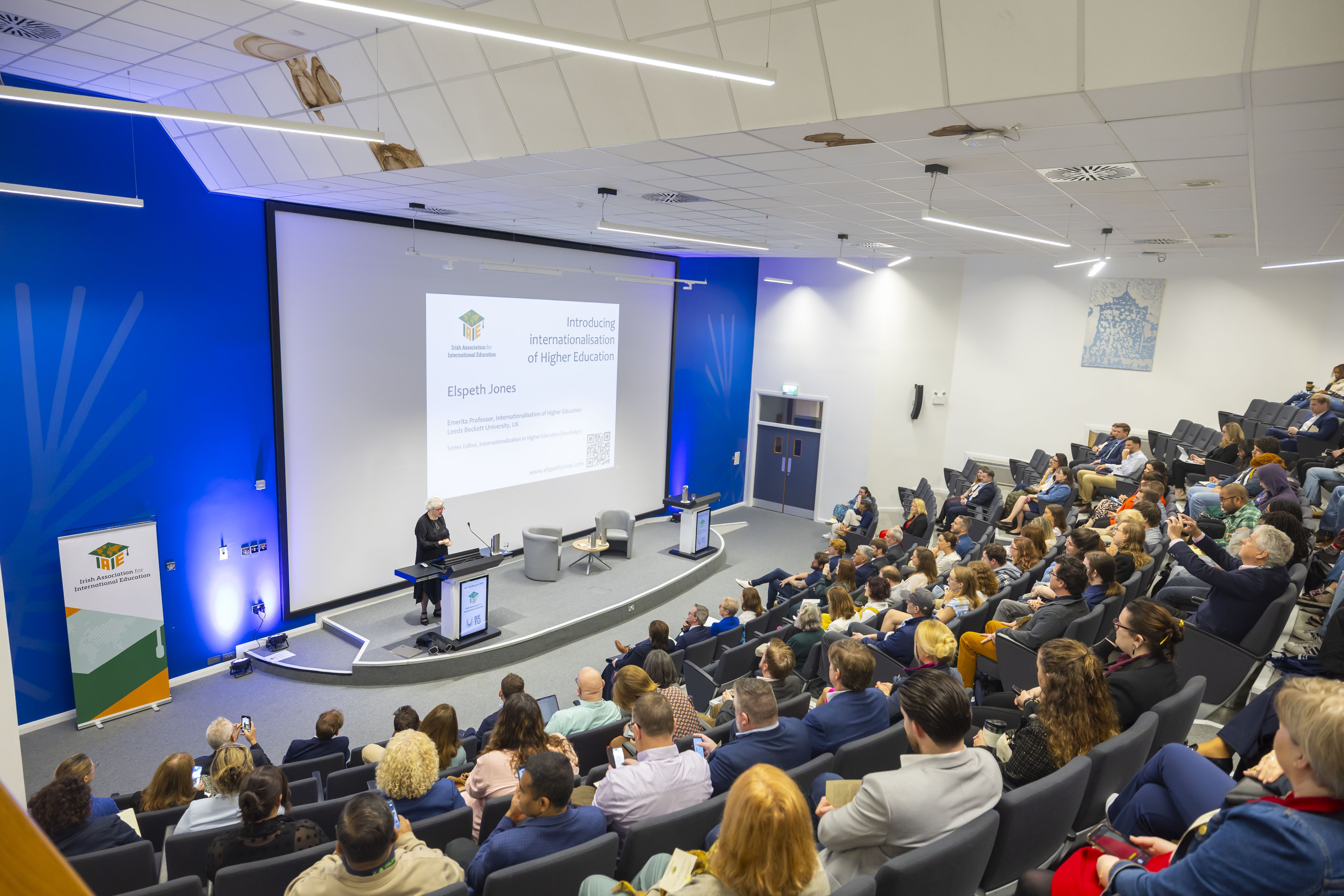
The conference’s keynote speakers brought global insight and inspiration. Professor Elspeth Jones, Leeds Beckett University, UK, challenged institutions to move beyond surface-level internationalisation and to embrace “interculturalisation”. This refers to embedding intercultural competence, inclusivity, and sustainability into the curriculum. She emphasised that internationalisation must serve all students, not just the mobile few, and called for a values-driven approach that fosters global citizenship and social responsibility
Dr Anthony Manning, of University of Kent, UK, shared practical strategies for internationalisation at home (IaH), highlighting its role in democratising global learning. He underscored how IaH can build intercultural competencies without requiring physical mobility. This makes internationalisation more inclusive, sustainable, and accessible to students who may face barriers to studying abroad.
Andrew Gordon, of DA Global Access Network, USA, spoke powerfully about the need to centre equality, diversity, and inclusion (EDI) in global education. Drawing on nearly two decades of work, he urged institutions to dismantle systemic barriers and ensure that all students, especially those from underrepresented backgrounds, have access to transformative international experiences. In response to Dr Allison Kenneally, SETU’s Vice President for EDI, Andrew reflected how studying abroad didn’t just broaden his perspective, it reshaped his life. He called for a sector-wide commitment to inclusive global engagement.
Panel discussions
A highlight of the conference was an engaging roundtable session, chaired by Dr Lauren McNamara, featuring expert contributions from Laura Harmon, ICOS and Seanad Éireann, Tim Conlon, HEA, Jennifer Cleary, IUA, Seán O’Reilly, TUA, Dr Waseem Akhtar, HECA, and Dr Melissa Whatley, William and Mary College, USA.
The panel explored critical perspectives and shared strategies shaping the future of internationalisation in higher education. The panel responded to questions around funding, sustainability, global citizenship, and the future of Irish internationalisation strategy.
“If we could address the silos within higher education, we would achieve a vastly disproportionate amount of change and impact. This organisation and this event could be a wonderful opportunity to do so,” said Seán O’Reilly, TUA.
Another standout moment was a plenary session on European University Alliances, where representatives from Ireland’s University Alliances outlined the pivotal role alliances play in advancing internationalisation through interdisciplinary student and staff engagement.
Representatives included Aoife Dowling, UNIC and UCC, Evan Connor, Una Europa and EngageAll, UCD, Dr Mike Kinsella and Santiago Dei Cas, EU-CONEXUS, SETU, and Barry Dignam, FilmEU, IADT. The session was chaired by David Denieffe, Vice President for Student Experience at SETU, and coordinated by Siobhán Rudden, EU-CONEXUS Institutional Coordinator at SETU.

Engaged and Insightful Industry participation
Commercial partners at the conference were not just present to promote services, they actively contributed to the dialogue on internationalisation. StudyPortals shared valuable data insights highlighting a growing demand among U.S. students for study opportunities in Ireland.
Keystone explored the power of LinkedIn as a key platform for reaching prospective international students interested in studying in Ireland. Edukudu showcased innovative approaches to customised outreach, while the Ireland Education Office offered strategic perspectives on enhancing Ireland’s global competitiveness in higher education. Their contributions underscored the importance of cross-sector collaboration in shaping the future of international engagement.
Looking ahead
The conference marks a significant milestone in Ireland’s international education journey. SETU’s own strategic plan for global engagement, launching later this month, aligns with the national Global Citizens 2030 Strategy, emphasising equality, innovation, and sustainability.
“This is just a first step,” said Dr Don O’Neill, and on behalf of the IAIE organising committee, “with the support of colleagues from all sectors, the IAIE is poised to become a vital platform for dialogue, policy shaping, and sector-wide collaboration”.
The momentum continues in 2026, with the next IAIE conference set to take place at Mary Immaculate College (MIC), Limerick. For those who missed this year’s event, it’s a valuable opportunity to engage with the growing IAIE community and help shape the future of internationalisation in Irish higher education.
Looking ahead, the IAIE also plans to initiate a sector-wide discussion on the future direction of the association, including the development of formal structures to support its long-term impact and sustainability.