


The music of legendary jazz guitarist Django Reinhardt and its influence on generations of musicians was the focus of a recent research seminar at South East Technological University (SETU).
Dr Jeremiah Spillane, Lecturer in SETU’s Department of Education, shared insights from his doctoral research with colleagues in the Faculty of Education and Lifelong Learning as part of the Faculty’s Education Research Seminar Series.
His presentation, Django's Worlds: Exploring Influence, Mediation and Genre Formation in the Music of Django Reinhardt and the Genre of Jazz Manouche, drew on research completed at Goldsmiths, University of London.
The seminar explored how musical traditions develop, how musicians influence one another, and the important role that communities play in preserving and passing on musical knowledge.
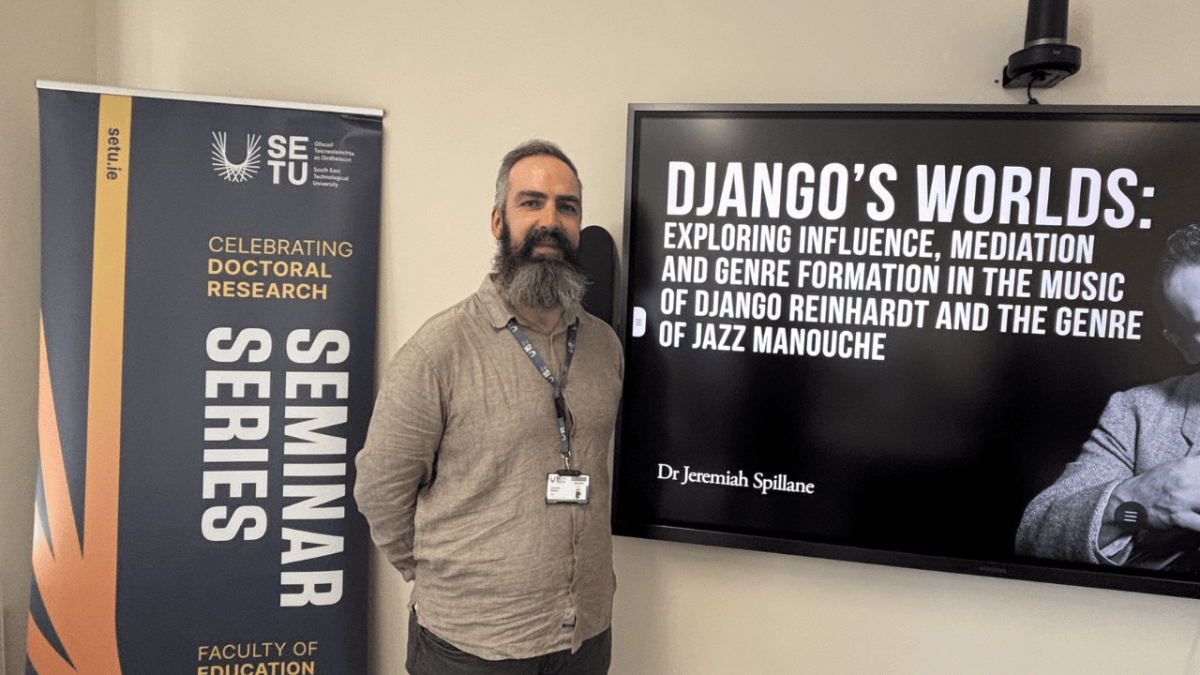
Exploring the musical world of Django Reinhardt
Widely regarded as one of the most influential jazz guitarists of the twentieth century, Belgian-born Romani musician Django Reinhardt (1910–1953) helped shape a distinctive style of jazz that continues to inspire musicians around the world.
Dr Spillane traced Reinhardt's musical development in Paris during the 1920s and 1930s, examining how he blended American jazz with European and Romani musical traditions to create a distinctive musical style.
The presentation also explored Reinhardt's response to changing trends in jazz following the Second World War, particularly the transition from swing to bebop, and how his musical legacy contributed to the emergence of jazz manouche as a recognised genre.
Today, this musical tradition continues to thrive through communities of musicians, both Romani and non-Romani, as well as through online networks that connect performers and enthusiasts internationally.
Understanding how musical influence works
A central theme of Dr Spillane's research was the concept of musical influence and how it extends beyond the relationship between individual musicians.
Rather than viewing influence as something passed directly from one artist to another, his research examines the complex interactions between musicians, recordings, technologies, communities and cultural traditions.
Drawing on archival research, musical analysis, interviews and participant observation, Dr Spillane developed a framework for understanding how musical ideas are shared, adapted and passed between generations.
He also introduced the concept of shared 'musical sociolects', or common musical languages developed within communities of musicians, highlighting the role of informal learning and collective knowledge in shaping musical traditions.
"Influence is typically treated as a simple line from one musician to another, usually without deeper investigation," Dr Spillane explained.
"What the research shows is that it's far more of a complex network, shaped by recordings, scenes, communities and the stories people tell about the music. This way of thinking applies well beyond jazz, and directly speaks to how we learn and teach."
Connecting music research with education and lifelong learning
The presentation prompted a lively discussion among attendees, exploring themes including literacy, ethnicity, prejudice, communities of practice and the different ways people acquire knowledge and skills outside formal educational settings.
These discussions highlighted the wider relevance of Dr Spillane's research to education and lifelong learning, particularly the importance of community participation, cultural exchange and informal learning in developing and sharing knowledge.
The Faculty of Education and Lifelong Learning's Education Research Seminar Series provides a regular forum for SETU staff to share research findings, exchange ideas and explore developments in teaching, learning and academic practice.
The next seminar in the series will feature Dr Lána McCarthy and is scheduled to take place on Wednesday, 11 November 2026.