
Springboard+ is co-funded by the Government of Ireland and the European Union. Please see www.eufunds.ie for further details

FAO Applicants Resident in Ireland: Springboard+ Funding
This course has been funded under the Irish Government’s ‘Springboard+’ programme, for more information on the fee structure please head to the Springboard+ website here. To be eligible you need to be:
- Resident in Ireland - either with a valid social welfare claim in place for unemployed people; or, for employed people, proof of having been resident here for 3 out of last 5 years.
- Non-EU Irish residents must have ‘Stamp 4’ residency immigration status or above in order to be eligible.
- Recent Graduates of full-time level 8 degree programmes are not eligible for Springboard+ funding for one year after graduation date but may apply as fee-paying students.
- The funding is not open to people who are not resident in Ireland. Please see further information on Springboard+ eligibility.
- The Springboard+ application closing date is Monday, 14 September 2026.
About Programme
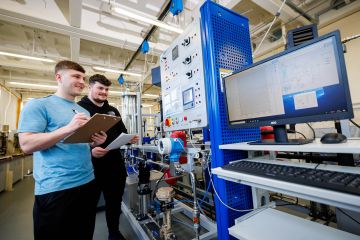
Instrumentation is a wide and varied branch of engineering essential to the success of complex modern production processes in almost every industrial sector. While instrumentation can be considered as two distinct areas, the devices that Measure process parameters such as temperature, pressure, level etc., and the equipment and systems that take corrective action or Control the value of these variables, the range of technologies required to implement instrumentation systems is very broad.
This progression programme is suited to applicants who have completed an Electrical, Mechanical or similar apprenticeship, or holders of a Level 6 Higher Certificate in a related discipline, and wish to specialise in instrumentation.
This blended delivery programme consists of one full day per week on campus at SETU in Carlow, and one evening per week online from September to June. Class sizes will remain small to ensure a low ratio of lecturer to student for both theory and practical classes in specialised instrumentation laboratories.
This course is comprised of 6 x 5-credit modules deliver over 2 Semesters. Semester 1 will commence mid-September until mid-February, and Semester 2 will run from mid-February until mid-June.
Process Measurements 1:
Students will develop an understanding of the principles of operation for a range of industrial instruments used to measure Pressure, Level and Temperature.
At the end of this module, students will be able to
• Interpret and apply the terminology and methods used to describe the specification and performance of industrial measurements instruments.
• Explain the principles of operation of the most common instruments used to measure Pressure, Level and Temperature in industrial applications.
• Implement the equipment and procedural requirements for bench and field calibration of a range of the instruments covered.
• Discuss the relevant process and application parameters for correct instrument selection and installation.
Automatic Control 1:
This module will enable students to develop an understanding of PID automatic control systems and to select and apply appropriate control strategies for simple applications.
At the end of this module, students will be able to
• Classify and discuss the objectives and principle of operation of general closed-loop automatic control systems.
• Determine how different process characteristics will contribute to the control system response and performance.
• Explain the principles of different control modes.
• Apply different control modes based on process requirements to basic applications.
Validation and Quality:
To aim of this module is to enable the learner to develop their understanding and knowledge of quality and validation in regulated sectors in the context of Measurement, Control and Automation technology.
• Explain terms and concepts relevant to quality and their requirement within regulated industries.
• Explain the principles surrounding quality management systems and how quality management systems are operated, applied, implemented and reviewed.
• Demonstrate knowledge of the principles of validation and regulatory requirements in a regulated industry.
• Develop basic quality/validation documentation, (such as change control, calibration failure protocols, customer complaints and surveillance programmes) for Engineering systems.
Process Measurements 2:
This module will provide students with an in-depth understanding of the design, operation and application of Flow Measurement, Smart Instrumentation, Weighing Systems and Explosive Atmospheres.
At the end of this module, students will be able to
• Demonstrate knowledge of the principles of operation for Flow Measurement, Smart Instrumentation, Weighing Systems and Explosive Atmospheres safety systems.
• Determine appropriate safety precautions for working in explosive atmospheres.
• Select and apply the appropriate type of instrument to suit specific process applications.
• Implement correct configuration, calibration, and diagnostic procedures for a range of smart instruments.
Automatic Control 2:
This module will introduce multi-variable control systems, control valve applications and to enable students to develop the knowledge and skills necessary to optimize PID control system parameters.
At the end of this module, students will be able to
• Apply appropriate control strategies to a range of multi-variable process systems.
• Specify suitable control valves, and ancillary associated equipment, for a range of different process applications.
• Determine correct equipment configuration and controller settings for safe and stable control.
• Optimise “as found” PID controller tuning.
Health and Safety:
This module covers the key requirements of the health and safety legislation including Machinery Directives, the role and contents of the safety statement and accident prevention within an industrial environment.
At the end of this module, students will be able to
• Demonstrate knowledge of the key requirements of the Safety Health and Welfare at Work framework legislation including the Machinery Directive 2006/42/EC
• Explain the concept of risk management and apply the hazard identification and risk assessment process
• Implement accident reporting and investigation in accordance with legislative requirements.
• Demonstrate a working knowledge of a Safety Statement and its content.
Applicants for the Level 7 Minor Award must have completed an apprenticeship in a related discipline, such as Electrical, Mechanical, Electronic Security Systems or similar.
The programme is also suitable for learners that have engineering or technical experience and a minimum Level 6 Higher Certificate (or equivalent). The qualification will typically be in the area of Electronics, Electrical, Automation or Mechanical engineering.
Applicants who do not currently meet the academic entry requirements may wish to consider using Recognition of Prior Learning (RPL) mechanism.
Applicants whose first language is not English must submit evidence of competency in English.
On successful competition of this program, students can progress into the final year of the part-time level 7 Bachelor of Science in Industrial Measurement and Control degree.

Course question

Have a question about
this course?
Our team is here to help.
If you have any questions about this course, please get in touch and we'll be happy to assist.
Part-time Prospectus
Explore our Part-time Prospectus to see the range of flexible study options available, with detailed course information, entry requirements, and study formats. Download the prospectus to find a programme that fits around your work and other commitments.
View Here