The online Higher Diploma in Science in Computer Science is a flexible, part-time ICT conversion programme designed to allow honours graduates from non-computing disciplines to acquire the industry-relevant ICT and software development skills, expertise and practical experience required to become suitable candidates for employment in the ICT domain.
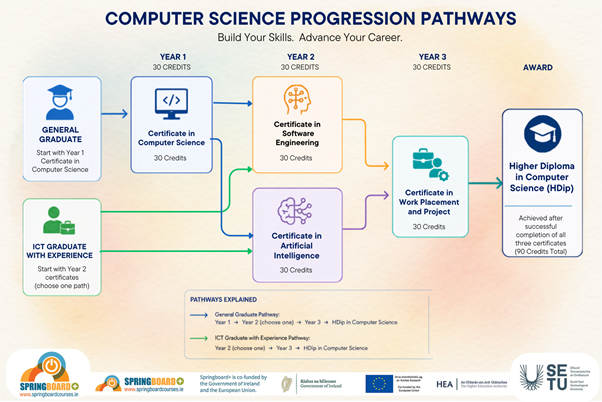
The programme is structured as three stackable 30-credit certificates. Depending on your previous qualifications and professional experience, you may begin with the Certificate in Computer Science or enter directly into one of the specialist certificates.
Students who successfully complete 90 credits-including the Certificate in Work Placement and Project-are eligible for the Higher Diploma in Science in Computer Science.
Fully online, part-time delivery
Level 8 award
90 credits in total
Stackable 30-credit certificates
Software Engineering or Artificial Intelligence pathway
Work placement and project
General graduates normally begin with the Certificate in Computer Science. Applicants with an appropriate ICT qualification and relevant experience may be eligible to enter directly into a specialist certificate.
General graduate entry
This route is intended for honours graduates from non-computing disciplines. Students begin with the 30-credit Certificate in Computer Science, which develops the essential foundations in programming, web development, computer systems, networks and databases. You then choose either the Certificate in Software Engineering or the Certificate in Artificial Intelligence, followed by the Certificate in Work Placement and Project. Successful completion of all three certificates(90 credits in total) leads to the Higher Diploma in Science in Computer Science.
ICT graduate or experienced applicant
Applicants with an appropriate ICT qualification and relevant professional experience may be eligible to begin directly with either the Certificate in Software Engineering or the Certificate in Artificial Intelligence.
After completing the chosen specialist certificate and the Certificate in Work Placement and Project, students may combine these credits with recognised prior learning to meet the requirements of the Higher Diploma. Eligibility is assessed through SETU’s admissions and Recognition of Prior Learning processes.
Delivery
The course is delivered using our award-winning online delivery platform – TutorStack, in Agile Semesters typically consisting of 4, three-week sprints followed by 1-week breaks for retrospective, after each sprint.
Average time commitment is 16 hrs per week. Online delivery over the two years is supplemented by four onsite workshops to further enhance and deepen the learning experience.
Year 1
This is the foundation certificate for graduates entering computing from another discipline.
Certificate in Computer Science - 30 credits
Semester 1
Semester 2
Programming Fundamentals - 10 credits
Computer Systems and Networks - 10 credits
Web Development - 5 credits
Database Design and Implementation - 5 credits
Year 2
Students choose either Software Engineering OR AI/ML Pathway
Certificate in Software Engineering - 30 credits
Semester 1
Semester 2
Web Application Development - 10 credits
Mobile Application Development OR Computer Security and Forensics - 10 credits
Developer Operations - 5 credits
Front End Web Applications Development - 5 credits
Data Handling and Infrastructure for AI - 10 credits
Applied AI Project - 10 credits
The Evolution of Machine Learning and AI - 5 credits
Building Machine Learning Models for AI Systems - 5 credits
Year 3 (6 months)
Certificate in Work Placement and Project - 30 credits
Students consolidate their learning through a substantial supervised computing project. The project is supported by either relevant work experience in an ICT or software-development environment or an approved professional-certification pathway. Students undertake a structured research, analysis, methodology and planning phase before completing the main project. An academic supervisor supports each student throughout the module.
Entry to the foundation pathway
Applicants should normally hold an honours bachelors degree at Level 8 in a non-computing discipline and demonstrate the capacity and aptitude to complete an intensive computing programme.
Entry to a specialist pathway
Applicants with an appropriate Level 7 or Level 8 ICT qualification and relevant experience may be considered for direct entry to the Certificate in Software Engineering or Certificate in Artificial Intelligence.
Graduates of the SETU Certificate in Computer Science may progress to either specialist certificate/pathways.
Recognition of Prior Learning
Applicants who do not meet the standard entry requirements but have substantial relevant education or professional experience may apply through SETU’s Recognition of Prior Learning process
Roles for HDip in Computer Science Graduates
The HDip in Computer Science is designed to produce the programmers and software developers. These skills are in massive demand across multiple sectors including:
Manufacturing / Logistics / Industrial Control and Automation
Advertising & Media
Enterprise Software Services
Specific skills areas:
Programming
Developer Operations
IT Administration & Management
Web Development
Systems Administration
Technical Support
Sample job title:
Software Developer
DevOps Administrator
System Administrator
Support Engineer
Web Designer / Developer
Business Systems Analyst
Student Testimonials
The online Higher Diploma in Computer Science has allowed me to undertake my studies with great flexibility in such a way that a standard face-to-face course could not. I had no prior experience of online learning, and my experience has been immensely positive and allowed me to adapt my studies around my full-time job. The lecturers are very knowledgeable, and they often go out of their way to support any questions or advice. I’ve been impressed by their methods of delivering the online lectures and the step-by-step content for the accompanying lab work and adopting the latest technologies. I also found the optional onsite days well organised and they were a good opportunity to meet industry partners. The course offers a good variety of modules that cater to the essential skills for emerging software developers.
Julianne Daly: Data Analyst at VHI
“The ICT Conversion in SETU has been a great innovation. With the current demand for Software Engineers in Ireland and the South East, SETU has succeeded in developing a programme that equips graduates from other disciplines to transfer directly into IT. The fact that graduates are already equipped with excellent problem-solving, teamwork and communication skills from their previous disciplines makes them very attractive to employers.”
Declan Lawlor: Chief Technical Officer at Done Deal
“I have a background in IT and being working in the field for 15+ years. Working full time and have a little one at home gives me very little time to upskill, to physically go to a classroom. The HDIP online programme program not only allowed me to explore my own areas of interest, while learning valuable technical skills, and providing a thorough grounding in learning theories, current and emerging technologies in this space but above all allowed me to do it in my own time. I didn't feel any disconnect from classmates or faculty members by doing it online. The lecturers are excellent in their own fields, they are extremely patient and helpful, and my classmates were always active in our virtual “hangout” to answer questions, bounce ideas off and chat about assignments.”
Juber Nunes: Senior Quality Engineer (Automation & Performance) at Redhat
“Taking the leap and going for the Higher Diploma in SETU's Computer Science was a big move but from the onset I knew I was in good hands. Previously a graduate of Visual Communications I was looking for an avenue into the IT sector and this course came highly recommended. Although broad in scope the content is thorough and often challenging with plenty of room for innovation. Regardless of your background this course will help you find an area of expertise in the sector & with the high-demand for full-stack developers in the south east I can't recommend it highly enough. There's plenty of flexibility in the online delivery which is a game-changer if you're a busy professional or self-employed.”
Jim O’Brien: Business Owner, In Crowd Wedding Music
Having recently completed the Higher Diploma in Computer in SETU, Kevin can say it was a very rewarding experience. Prior to enrolling to the course, he had a Bachelors in Biochemistry but always had an interest in technology. The course arms you with core knowledge and skillset that is sought after within the ICT industry and coupled with the work placement, puts you ahead of competitors. Intensive, but will come out with a strong knowledge base to tackle even new technologies. The lecturers and staff were always helpful. This course has given Kevin the skillset and experience to transition into the IT industry and one that he would highly recommend to others. Following the placement Kevin was offered a full-time job with Errigal as a Software Developer.
South East Technological University is currently reaching to our employer networks to seek work placements for the graduate ICT programmes. The students are already qualified in various disciplines, have professional work experience, and are now pivoting towards tech related careers going forward.
Upskilling on Programming, Web Dev, Systems/ Networks, Database Design, Mobile App, Security/ Dev Ops/ Enterprise Web
Upskilling on Database design/ Data Analytics/ Enterprise Data exchange/ Software Eng/ SW validation/ UI UX design/ Project management
SETU graduate work placements are structured:
Based on a F/T job specification from the employer.
The employer has full autonomy on who to interview and select for placement
Students would be assigned a workplace mentor by employers.
SETU provides documentation; WP handbook, Insurance, learning agreement and log book template.
SETU work placement co-ordinator will visit onsite with the student and mentor once during the placement period and is available to both employers and students throughout the placement period.
Joan Mangan works with our ICT students and employer partners from the outset of the course in order to match students with a productive and fulfilling work placement experience. Within the ICT networks, it has been our experience that work placements frequently lead to longer term job offers after the official placement period has ended.